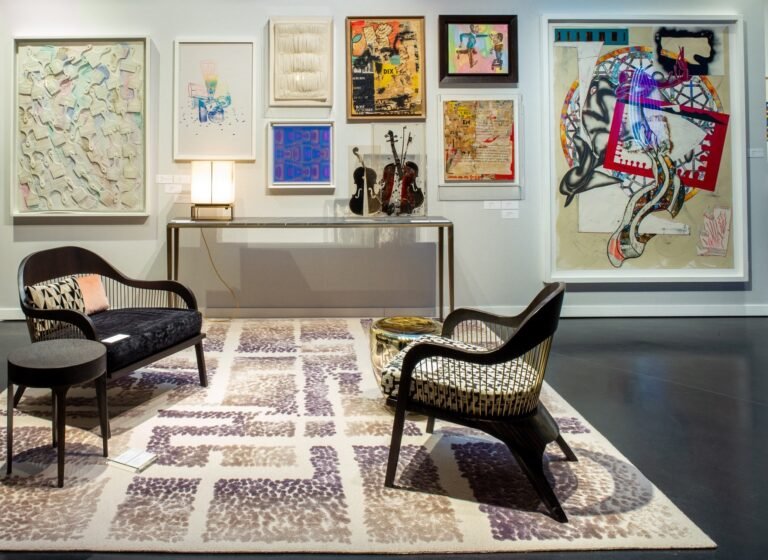
Papers and Wood, a collective exhibition that focuses on the media used to create art.
«Papers and Wood», a collective exhibition that focuses on the media used to create art. Hatchikian Gallery has invited artists from different backgrounds to present their work in a space that feels like a curiosity cabinet, with a nearly labyrinthine layout.
Paper: a centuries-old medium of creation.
Paper is one of the materials used in various artistic techniques such as painting, engraving or drawing. Paper is primarily of plant origin, but it can also be of animal or synthetic origin. Originally, it was made from reeds or mulberry bark. Composed of intertwined fibers, these are reduced into a paste. A metal sieve is immersed in this paste until the sieve is completely covered. Once drained and dried in the sun, the paste becomes paper, the quantity of which determines the thickness. Paper originated in China around the end of the IIIthe 2nd century before the Christian era, under the reign of Emperor Chiuangdi (Qin dynasty). In the VIIIthe 2nd In the 11th century, the Arabs learned the Chinese art of paper making, and gradually transmitted it to the West. In the 15th century, the Chinese paper industry began to develop rapidly.the 2nd In the century that followed, the invention of typography by Gutenberg increased the consumption of paper. But it was in the nineteenth century that the printing press became a real innovation.the 2nd The century in which the paper industry truly takes off. The following century sees it become the heavy industry we know today. Paper has always accompanied human activity and development, including artistic activities that in turn ensured the prosperity of the peoples who mastered its manufacture.
Papers and Wood, the artists of paper: Toxic, Niels Meulman and Rodolphe Barsikian.
Toxic
Born in the South Bronx in 1965 in a family with Caribbean and Indian origins, Toxic (Torrick Ablack) He began doing graffiti at the age of 13. A soldier in the TMK (Tag Master Killers) army of Rammellzee, he was more a brother than a companion for Jean-Michel Basquiat; all three were later brought together in the Hollywood Africans gang, immortalized in 1983 by a triple portrait signed by Basquiat that is now kept at the Whitney Museum in New York. Alongside a few other rare witnesses, Toxic is today the last survivor of a powerful group that was extremely influential in the graffiti scene of the 1980s. Colors, symbols, cabalistic references, and personal memories find their place in the artist’s paintings, and their particularly sophisticated abstract pictorial space. His works are exhibited in several international museums and are part of private collections around the world.
Niels (Shoe) Meulman
Born and raised in Amsterdam, Shoes He joined the graffiti scene in the city, which was rooted in a strange mix of subcultures; punk bands, football hooligans, and squatters. However, in the early 1990s, he was one of those kids who made the transition from that scene when hip-hop came along and went to New York where he met some graffiti icons, including Rammellzee, Dondi White, and Keith Haring. That’s where it all began for him. He never went to a formal art school, but he was educated in graphic techniques like typography primarily as well as screen printing. Speaking of influences, on a popular and conceptual level.
Rodolphe Barsikian
Rodolphe Barsikian Rodolphe has set out on an atypical artistic path. Of Armenian and Italian descent, he grew up in Sarcelles. His entire childhood was immersed in the multicultural vibrancy of this suburb. He developed a curiosity for all forms of expression and rejected the obvious. His taste for contrast and the raw became refined and directed his sensibility towards the visual arts. Painting, gouache, fusain, and pencil would be his first mediums. He discovered an obsession with line and created a multitude of sketches in a near-hypnotic state in his student room. With vector graphics, Rodolphe made a clear choice: to combine rigor and creativity with the freedom to realize his work on a multitude of media without ever being confined to any one of them.
The works on paper by these three artists can be found in the exhibition Papers and Wood.
Wood: a support for millennia of creation.
In the memory of man, wood has always been used for utilitarian purposes to build shelters, houses, tools… It has played a significant role in the development of humanity over the ages. In the wake of this development, numerous civilizations have produced their art using this material: we can find traces of wood sculptures dating back to the Stone Age. Wood sculpture is also ubiquitous in the early Mesopotamian and Egyptian civilizations, as well as in African statuary, Aboriginal art, or Native American art. Thus, wood sculpture has survived the ages and evolved with the changing societies, fashions, and behaviors to eventually lead to the contemporary wood sculptures that we are fortunate to be able to observe today.
Papers and Wood, the artists of wood: Steph.Cop, Vincent Abadie Hafez and Sacha Haillote.
Steph.Cop
Since he settled in the deepest part of the Morvan, Steph Cop has made his way, tirelessly exploring the forests of the dark mountains in search of these fallen trees that some usually destine to the domestic hearth but from whose heart he reveals, in the clink of the chains of his chainsaws, the Wooden Aro, the constantly reinvented incarnation of his emotions. Steph Cop is not ready to reach his goal, as he always has to go further, higher, constantly resorting to new techniques or woods, from the Japanese Shou-sugi-ban to the Atlas cedar, when it is not a matter of taming bronze or Carrara marble. Study occupies a special place in the work of the contemporary sculptor, who carves with gouge and knife maquettes of a few centimeters or uses his pastels against metal and paper.
Vincent Abadie Hafez
Cosmopolitan, Vincent Abadie Hafez’s work is the result of a mixture of cultures and the confluence of several different styles. In 1989, under the pseudonym Zepha, he began his involvement in the graffiti movement. It was in the Parisian suburbs that he began to establish his own name and that of his team; he has not stopped since… He takes over public space and disrupts certain visual habits: an utopian graphic battle against a system driven by a wild liberalism that eats up men and its terrible offspring, advertising. Vincent Abadie Hafez develops a graphic universe and a visual language through which the influence of the artisanal work of ancient civilizations, calligraphy, the immediacy of the movement of free figuration, the spontaneity of lyrical abstraction, and finally the random risk-taking of graffiti intersect. Arabic calligraphy strongly influences his work through his encounter with the Moroccan calligrapher Abdelatif Moustad and his discovery of the Sudanese artist Ahmed Abdel Aal and the Iraqi artist Hassan Massoudy.
Sacha Haillote
A prolific artist with diverse and colorful mediums, Sacha Haillote, trained at the Camondo school, is a young woman of her time, well rooted in reality, who gives us a glimpse, with emotion, sometimes with a certain acidity, but never without humor, of the woman of the 21st century. Sacha shows us her beauty, her aspirations, her madness and her tournaments. The woman has no secret for her; she is the Woman, femininity in all that makes her up, from «girly» flirtations to strong friendships; nothing is forgotten. Seduction is always present, Eros is never far away, Thanatos is not her subject…
Image gallery