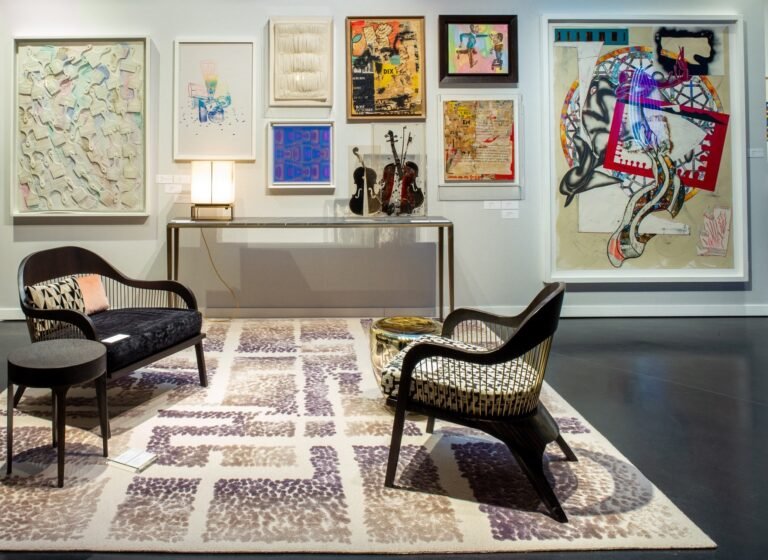
Starting April 9th, Audrey Hatchikian is pleased to present the exhibition Prints Masters, which aims to introduce works by established artists whose artistic practice has often focused on the printing of silkscreens and lithographs. Through free-form figuration, narrative figuration, new realism, Op Art and to combat the boredom of confinement, discover the works of Robert Combas, Jacques Monory, Mimmo Rotella, Gérard Schlosser, Victor Vasarely and Jacques Villeglé.
Robert Combas
Robert Combas is the initiator of the free-form figurative art movement, of which he is the leader in Europe, highly recognized and celebrated in France since the 1980s; today he is considered one of the most important living French artists.
Jacques Monory
Jacques Monory is one of the main representatives of the narrative figuration movement, which, in the mid-1960s, opposed abstract painting with, among others, the painters Hervé Télémaques, Erro, Bernard Rancillac and Peter Klasen. Deeply concerned with the violence of everyday life, Monory’s paintings suggest, with great aestheticism, heavy and threatening atmospheres.
Mimmo Rotella
Mimmo Rotella is an Italian artist and poet known for his collages made from torn advertising flyers that he calls «double decollages». Alongside Raymond Hains, Jacques Villeglé and François Dufrêne, he became one of the Poster artists, a group of artists considered a pioneer of Street art.
Gérard Schlosser
From his very first canvases, Gérard Schlosser chose figuration: fragments of bodies painted in flat areas and outlined in black. These works are not without recalling the research of the Pop Art artists. As early as 1967, he systematically enlarged his canvases with sand, which gives the colored surfaces a very particular vibration: each tiny grain adds the depth of its own modeling with a part of shadow and a part of light. « Schlosser is a camera-eye, the camera-eye of a painter-cinematographer, and not just an eye. But this camera-eye — and this eye — are, like those of a filmmaker, inextricably linked to the rhythms of time, the rhythms of the spaces of a society ». Alain Jouffroy
Victor Vasarely
Victor Vasarely is considered the father of optical art or Op art. Vasarely’s paintings and sculptures use geometric shapes and color to create illusions of spatial depth on two-dimensional surfaces. This abstract method of painting, also known as kinetic art, draws on the principles of the Bauhaus.
Jacques Villeglé
Jacques Villeglé was a French painter and sculptor, a founding member of the New Realists. He is considered the leader of the affichists. In the early 1950s, Villeglé referred to himself as an affichist and revealed the «guerrilla of signs». He kept a «journal of the street world». He collected, classified and displayed his posters, «a reflection of dominant culture». He wanted to create a popular work and provide a testimony of the life of an era (political, social, cultural context).
Image gallery