
The unspeakable, the intangible, the ineffable: during his dazzling life, Yves Klein sought to capture them. materialize in the language of pigments.
Klein Blue or International Klein Blue, emblematic of the work
Blue, a revelation: this saturated overseas blue, IKB, combined with a fixing agent that allows it to maintain its intensity, forms the paradigm of a flamboyant work driven by the idea of a universal permeation through color. A «beyond-blue» blue that radiates vibrations of the mind. For Yves Klein, it is the most abstract color: « Blue has no dimension; it is beyond dimensions. All colors bring associations of concrete ideas, while blue at most evokes the sea and the sky, which is the most abstract thing in tangible and visible nature. ». The IKB blue was developed with a chemist from the pharmaceutical industry who helped the artist find an adjuvant, a synthetic resin that will be named Rhodopas, whose property is to shrink when dried to reveal and reveal the pure pigment.".
Monochromism, a quest for the absolute
The monochromatic proposals in pure pigments by Yves Klein are conceived as a way of capturing energy, emotion, and intuition. Monochromaticity frees color from the constraints of line to make the absolute visible. « To paint space, I must go there, to that very space, without tricks or gimmicks. Never has the line enabled us to create a fourth or fifth dimension in painting. », He claimed in 1946. Blue, in particular, is for him a representation of the infinite of the world, of the immaterial dimension of the universe. For the artist, it is about approaching an immanent reality and bringing it to consciousness through this language of color, reaching « the pictorial sensitivity of the indefinable ». Pure color allows us to transcribe sensory perceptions in an absolute form, outside the filter of reason. This quest for the absolute is the matrix of the work, in practice as well as in its transmission: Yves Klein indeed developed the project of an Artistic School of Sensibility. In his view, the role of the artist is to make visible the beauty already present in the invisible state. « Art is everywhere where the artist arrives. ». Yves Klein’s work transcends abstract and figurative categories to unfold as a formal expression of sensibility, which attests to the artist’s relationship with the entire universe.
A pioneering approach that breaks down the categories of Art
In 1960, Yves Klein and the art critic Pierre Restany founded the New Realists, an artistic approach aiming at new perceptual approaches to reality, for a return to reality that is as distinct from abstraction as it is from figuration. The founding declaration of the group, which was dissolved in 1966, was signed by Arman, Martial Raysse, Jean Tinguely, Jacques Villeglé, among other figures of the avant-garde of the 1960s. The object was used by the New Realists as material in the work, and art took innovative and diverse forms, from painting, sculpture, collage, accumulation, to performance. A year later, in 1961, Yves Klein presented the Manifesto of the Hotel Chelsea (the mythical hotel of the rebellious New York of the 1960s), a text in which he outlined his artistic propos, a relationship to the world mediated by Art. A text in which he justified his position as an artist of the immaterial and which begins with these words: « Having painted monochromes for fifteen years, having created states of immaterial painting, having manipulated the forces of emptiness, having sculpted fire and water, and having, from fire and water, used living brushes to paint, having invented the architecture and urbanism of the air… » in the preamble to a defense of his conception of the future of art.
From a distinguished judoka to a daring artist
Born in Nice in 1928, Yves Klein grew up in front of the spectacle of infinite azure blue. He painted his first blue monochromes on the walls of a cellar belonging to Arman’s family, a childhood friend. As a child, he was already drawing blue circles in his notebook, stating to Arman that he had to see there the future of painting. Yves Klein could have become a world-renowned judoka: in Japan, between 1952 and 1954, he was the first Frenchman to obtain his fourth dan at the Kodokan Institute. But this persistent questioning that calls for the language of art ultimately led him to the Monochrome Adventure. In the late 1950s, his career took on an international dimension with the various series that would punctuate a bold and innovative work between conceptual art and performances or happenings: monochromes, emptiness, live brushes, anthropometrics (of naked bodies covered in paint that would leave their marks on the canvas). « My goal is to extract and obtain the trace of the immediate in natural objects ».
Performances and immaterial works
Among his first immaterial works was a release of 1001 blue balloons into the sky of Paris, dubbed (Sculpture Aerostatique). With architect Claude Parent, he developed a project of’ « Architecture of Air », Between spiritual quest and utopian approach: an experiment for « make the void visible ». In the early 1960s he created his first Cosmogonies, works produced by atmospheric phenomena, or his Fire Paintings. Yves Klein played with elements: the breath of the wind, the burning of fire, the erosion of water, the imprint of time, the crystallization. He sought to capture, through the aesthetics of art, natural phenomena, « Moments of nature » in their impermanence and ephemeral dimension. A work of capturing the intangible through the mark and trace. An Art that infuses the viewer with a sense of the immensity. In 1961, in the gardens of the Krefeld Museum, Yves Klein created a Fire Wall composed of a double canvas of 50 welded burners facing each other on a grid of gas pipes, offering the spectacle of an incandescent projection. From there, he developed the technique of Fire Paintings, a dazzling artistic gesture performed with a gas burner, revealing halos of color on cardboard resistant to heat; for Yves Klein, the flame is the ultimate expression of the synthesis of the fundamental colors, blue, gold, and pink. The artist notes that the flame alternately takes on these three colors according to the intensity of the temperature. « Fire is truly one of the authentic principles that are essentially contradictory to one another, being at the same time the sweetness and the torture in the heart and the origin of our civilization. ».
The colors in pure pigments are the essence of the work
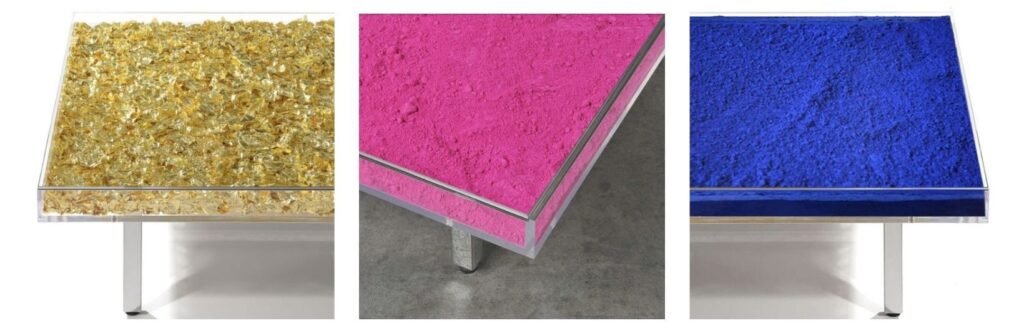
Although blue is undoubtedly associated with Yves Klein’s work, gold is also a unique marker of his artistic approach. The technique of foil gilding is a way of transforming matter into art. Pink, the third color in the artist’s trilogy, refers to the sensuality of the skin, used as a living paintbrush. The three colors appear together as a chromatic trilogy in several of his works: Ci-gît l’espace in 1960, Ex Voto dedicated to Saint Rita of Cascia in 1961. Yves Klein assigns these three colors the function of a Trinity: to gold the father, to blue the son, to pink the Holy Spirit; a Trinity that is expressed in an alchemical equation associating the sun (gold), water (blue), and blood (rose). More than colors, it is pigments that are worth talking about in the context of Yves Klein’s work: « I didn’t like the oil-based colors that were crushed. They seemed dead to me; what I liked most were the powdered pigments, as I often saw them in the wholesalers of color. They had an extraordinary shine and life of their own. That was the real color in itself. The possibility of letting the pigment grains be completely free, as they are in powder form, perhaps mixed but independent of each other, while all being similar, pleased me quite a lot. Art is total freedom; that is life. … ».
Hatchikian Gallery presents the Tables Yves Klein, a trilogy of fundamental colors
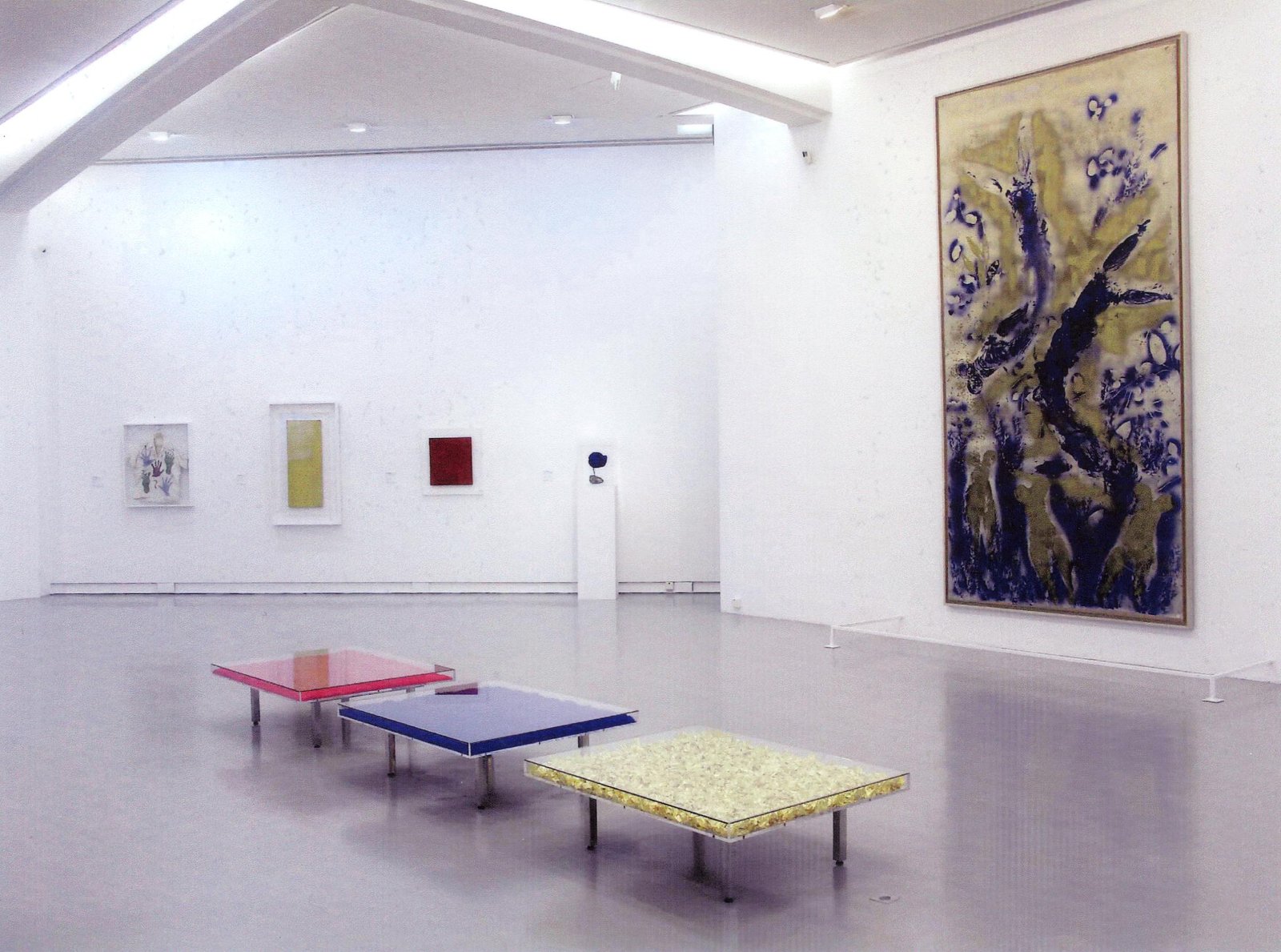
Hatchikian Gallery presents the Tables Yves Klein, signed works, rectangular coffee tables characterized by a glass and plexiglass tabletop in transparency on pigments of colors: three tables embody the emblematic IKB blue, gold and pink trilogy of the artist’s work. These works, available for purchase in the gallery’s collections, can be viewed by appointment at the Art Loft to appreciate their beauty in situ.
An immense work for a shortened life
Yves Klein’s career was meteoric: his work is immense, as is his quest for infinity, despite his premature death from a heart attack in 1962 at the age of 34. The legend lends these last confidences to the artist to a friend: « I am going to enter the largest workshop in the world; I will only make imaterial works there. ». Yves Klein joined the blue sky shortly after the screening at the Cannes Film Festival of Gualtiero Jacopetti’s film Mondo Cane, a film that ironically satirizes his eminently conceptual work. One year after the Manifesto of Chelsea, one can imagine how much the artist cared about defending and justifying his approach to the eternal detractors of the avant-garde. A room is dedicated to his blue monochromes at the MAMAC, the Museum of Contemporary Art in Nice, where numerous figures of the new realism are represented. Klein’s blue and that of the Bay of Angels never cease to illuminate us.