

For art lovers, destinations that offer both an exceptional environment and open-air museums are a true delight for aesthetes seeking escapades amidst spectacular works of art and architecture. From the nearby Provence to the distant Japanese islands, let’s visit two areas that have established themselves as indispensable artistic stops: Château La Coste, a wine estate on the foothills of the Luberon, and Naoshima, an island in the Seto Inland Sea in Japan. The link between the two? The architecture of Tadao Ando, winner of the 1995 Pritzker Prize, whose austerity sets a unique way of inscribing the built into the landscapes and capturing the light to create the design of art spaces that offer unprecedented visual and sensory experiences.
Tadao Ando, an architect of art.
Tadao Ando, born in 1941 in Osaka, pursued autodidactic architectural training before opening his own practice in 1969 and distinguishing himself through his achievements in various regions of the world. He was regularly asked to design art centers. Here we mention Château La Coste and the island of Naoshima, but it was Tadao Ando who also designed the foundations housing the Pinault collection: the Bourse de Commerce in Paris, Punta della Dogana and Palazzo Grassi in Venice. In Japan, he has designed museums in many cities. Tadao Ando works extensively on the idea of transition between the inside and the outside, between nature and the built environment, with buildings imbued with spirituality that are an invitation to be filled with the beauty surrounding them. «My architectures are open to the wind, to light and to shadow,» he explains, emphasizing the fact that «light gives movement to architecture, infusing it with life.» His work stems primarily from a play between shadow and light: «Architecture is a discipline that cannot be separated from light.» He claims to have a form of invisibility in his architecture; for him, architecture must disappear to make way for human experience: «I would like to build great things that are not seen. The void allows for creating greatness (…) In Japanese, there is a word, miegakure, that means two things at once: showing oneself and hiding oneself. This is the moment when the object shows itself and hides itself at the same time. In concrete terms, it is the art of not showing everything, of letting the subject’s eye move around. I seek a subtle harmony with the elements. If this harmony is not there, it is for me a failure.» Architecture, according to Tadao Ando, poses essential questions: «How do we build our world? How does the abstract world enter into dialogue with the concrete world?» What kind of conversation is possible between these two worlds? How can we maintain a connection with nature and not be cut off when we are inside a place? I believe that architecture should promote joy and be the place of encounter. If a building communicates nothing, it is not architecture. It is difficult to explain in words how architecture reveals itself, but it constantly raises the question of human identity. The silky concrete in Tadao Ando’s work is worked in a sculptural way that undeniably opens it up to art: «Architecture must welcome the joy of life in people. Otherwise, our bodies are not drawn to it.» Minimalism and abstraction in the Japanese architect’s work aim to liberate space for the body and the sensory experience. His architecture does not reduce itself to functional dimensions but fully incorporates the emotional component. For him, architecture must be close to the invisible and never conflict with the landscape.

Château La Coste: Art and architecture amidst the vineyards.
The history of the Château La Coste in Puy Sainte Réparade dates back to the 17th century, with the rise of viticulture, but the production of wine on the estate dates back more than 200 years before Christ: the Greeks, the Romans and then the monks successively cultivated the vines. Production was recently interrupted from the Second World War until the 1970s. Witnesses to this history, old buildings that form a hamlet around a fortified castle coexist today with the contemporary facilities erected under the direction of Patrick Mac Killen, owner since 2002. Passionate about contemporary art and architecture, he has created a veritable open-air art gallery in the heart of the few 220 hectares of vines. Renowned architects from all over the world have been invited to build buildings and pavilions. Tadao Ando is undoubtedly the one whose presence is the most structuring, but he also works alongside Franck Gehry, Jean Nouvel, Renzo Piano, Jean-Michel Wilmotte, Richard Rogers, and Oscar Niemeyer.

The Tadao Ando Art Center and the spider installation by Louise Bourgeois.
We enter the space through Tadao Ando’s long, sleek building of concrete, glass and metal, surrounded by a pond on which a monumental spider sculpture by Louise Bourgeois seems to be walking. The visitor is welcomed by a Calder mobile in the adjacent basin. The spectacular «Crushing Spider 6695» with steel and bronze legs stands out at the edge of the grounds with its powerful embodiment and its mirrored presence in the water, in the perspective of a horizon that is out of sight. In Louise Bourgeois’s work, the spider symbolizes the mother, so dear to the artist. As a child, she spent hours watching her mother work in her husband’s tapestry restoration workshop. The spider is that mother who weaves, protects and supports with her web. This work from 2003, in wrought bronze and twisted on fine steel legs that give it a graceful lightness, was installed shortly after the artist’s death in 2010. Several monumental spiders are on display in the world's largest museums, and this one seems to find a magnificent setting at Château La Coste.
The achievements of Tadao Ando punctuate the art exhibition at Château La Coste.
Further along the art trail between vineyards and the Provençal garrigue, Tadao Ando installed a chapel sculpted by light, whose entrance is signaled by a cross made of blown Murano glass by Jean-Michel Othoniel. A few steps away, another creation by Tadao Ando can be found: a wooden pavilion in the spirit of Japanese machiya houses, which one enters in a row like in a maze for a progressive immersion in darkness where one will discover the «Four Cubes to contemplate our environment», an ode to the natural elements. Tadao Ando also installed his origami benches along a wooded path, inviting to the art of contemplation: sitting on a bench and observing the imperceptible movement of nature. Tadao Ando has forged a genuine dialogue with Château La Coste: an architectural adventure that has decisively contributed to drawing the lines and perspectives of the estate’s environmental framework. The architect links the nature he celebrates and integrates into his works, and the art that nourishes his formal research and inspires his constructive gesture. Throughout his life, he developed many artistic affinities with major figures; Lee Ufan and his friendships with the artists were the origin of many of his projects.

The major figures of sculpture and artistic installations at Château La Coste.
At Château la coste, the architecture of Tadao Ando welcomes and punctuates the visit in a journey of art, for a long walk between installations and monumental sculptures. Ai Weiwei, Lee Ufan, Yoko Ono, Tom Shannon, Richard Long, Richard Serra, Jean-Michel Othoniel, Sean Scully, Liam Gillick, Andy Goldsworthy, Daniel Buren, Tracey Emin, Bob Dylan, Sophie Calle and many other major contemporary artists have been invited to design works, choosing their own location in the grounds. One of the latest works to find its place in the landscape is the work of the sculptor Prune Nourry, Mater Earth, a gigantic sculpture of a pregnant woman rooted in a one-to-one relationship with the earth, as ready to give birth. The visitor can enter the womb to experience a mystical and sensory immersion. The work took three years to complete and involved 80 people from 14 different trades. It is emblematic of the research of Prune Nourry, who tirelessly explores the anthropological mutations that traverse civilizations, through the prism of myths and foundational narratives that ensure the function of transmission.
Villa La Coste, a luxurious haven for a stay among the works of art.
At the heart of the estate, the intimate Villa La Coste offers a place to stay among the works of art and to enjoy the evening cultural events, especially during the summer season: concerts, films, performances. A luxurious setting that houses a collection of art composed of paintings by great masters and sculptures on a scale that matches the interior. Damien Hirst, Picasso, Fernand Léger, Maurizio Cattelan, Giacometti and many others coexist and are scattered throughout the villa’s spaces. Its 28 suites, its spa and its library, designed in a style of raw, natural materials imagined by the Hong Kong architect André Fu, are a veritable invitation to the aesthetic art of living. The furniture is the work of the great names of design: Jean Prouvé, Charlotte Perriand… The whole blends seamlessly into the vegetation. In the warmer months, the swimming pool is a source of well-being and regeneration. The hotel offers a bespoke stay for art enthusiasts, a discreet and exclusive luxury for an extraordinary experience.
The journey to Naoshima, a Japanese island dedicated to art.
Although Provence is a familiar destination, the trip to Naoshima, a Japanese island dedicated to art, takes us to the ends of the world for a total disconnection. The journey itself is an epic adventure: to get to Naoshima from Kyoto, Osaka, or Kobe, you first have to take the Shinkansen to Okayama (the fastest express is the Shinkansen Nozomi that connects Kyoto to Okayama in one hour). Next, you have to change in Okayama to Chayamachi on the JR Seto Ohashi line (20 minutes by train), before taking the local Uno line to the Uno port terminal (about 30 minutes by train). From the small arrival station, you have to reach the nearby ferry terminal (five minutes on foot) and buy your ticket for the ferry that serves the Miyanoura port on Naoshima. Trains and ferries are punctual and very well connected in these small stations where the changes are simple and everything is designed to ensure smooth connections.
An abandoned island that has become an essential artistic destination.
For lovers of contemporary art and architecture, the island of Naoshima in the Seto Inland Sea is a dream destination. This small island of 8 square kilometers, home to fewer than 3,500 inhabitants, was in decline when, in the early 1990s, entrepreneur and collector Soichiro Fukutake (Benesse Education Distance Learning), originally from Okayama, a coastal regional city, developed the project to revive the island’s dynamism through art – a political and social project in line with his educational commitments. Fukutake enlisted the architect Tadao Ando to build a museum hotel, the first of a series of buildings dedicated to art on the island, which has since continued to enrich its collections and venues dedicated to contemporary creation. The regional art festival – the Setouchi Triennial – helps make Naoshima and the archipelago an indispensable artistic destination.
Tadao Ando considers his work on the island of Naoshima as one of his most personal creations, emblematic of his commitment to the simplicity of volumes and forms, the purity of lines and perspectives in constant dialogue with the elements of water and wind. It should be noted that in Japan, Tadao Ando is celebrated as a national treasure, adorned with the most prestigious awards and distinctions. He has completed more than 300 projects ranging from housing to art centers, community spaces, spiritual buildings, and public buildings. Regarding Naoshima, he said: «One can give form to an idea, but everything that is physical is destined to disappear. In two hundred years, there will be little left of the museum in Naoshima. But the somewhat crazy idea of the businessman who wanted to turn this desperately deserted island into a world-class contemporary art museum will endure in the ruins.».
The Benesse Museum Hotel, with its architecture by Tadao Ando and being the focal point of the artistic itinerary.
The Benesse Hotel, its museum and sculpture park now constitute a central point on the island. It is the only hotel on the island (apart from a few traditional guesthouses) and it is strongly recommended to stay there to take advantage of all the artistic facilities and the facilities offered by the hotel. It is advisable to book in advance (also remember – it is important – to check the museum’s closing periods/days, to check on the Benesse Art Site website). You can stay in one of the rooms in the museum space, or in the buildings near the sculpture park and the beaches. The staff at the Benesse Hotel is attentive and welcoming: they will give you all the advice, information and help you need for an immersive stay on this artistic island. In each room, a unique work of art recalls the purpose of the site. The rooms are very clean and equipped with all the amenities of a high-end hotel, although the hotel primarily emphasizes simplicity. Note that it is best to avoid the rainy season from June to September because the walk could be ruined. One of the advantages of booking at Benesse is that you can take the hotel shuttle from the ferry upon arrival, which can either take you to the hotel or drop you off at the museum site before check-in (this avoids wasting time dropping off your luggage before the visits: the driver will take care of it and your suitcases will be waiting in the room). This shuttle is also very convenient and free for guests to walk between the various art venues during their stay on the island.

The Yellow Pumpkin sculpture by Yayoi Kusama on the seafront, a landmark work of Naoshima.
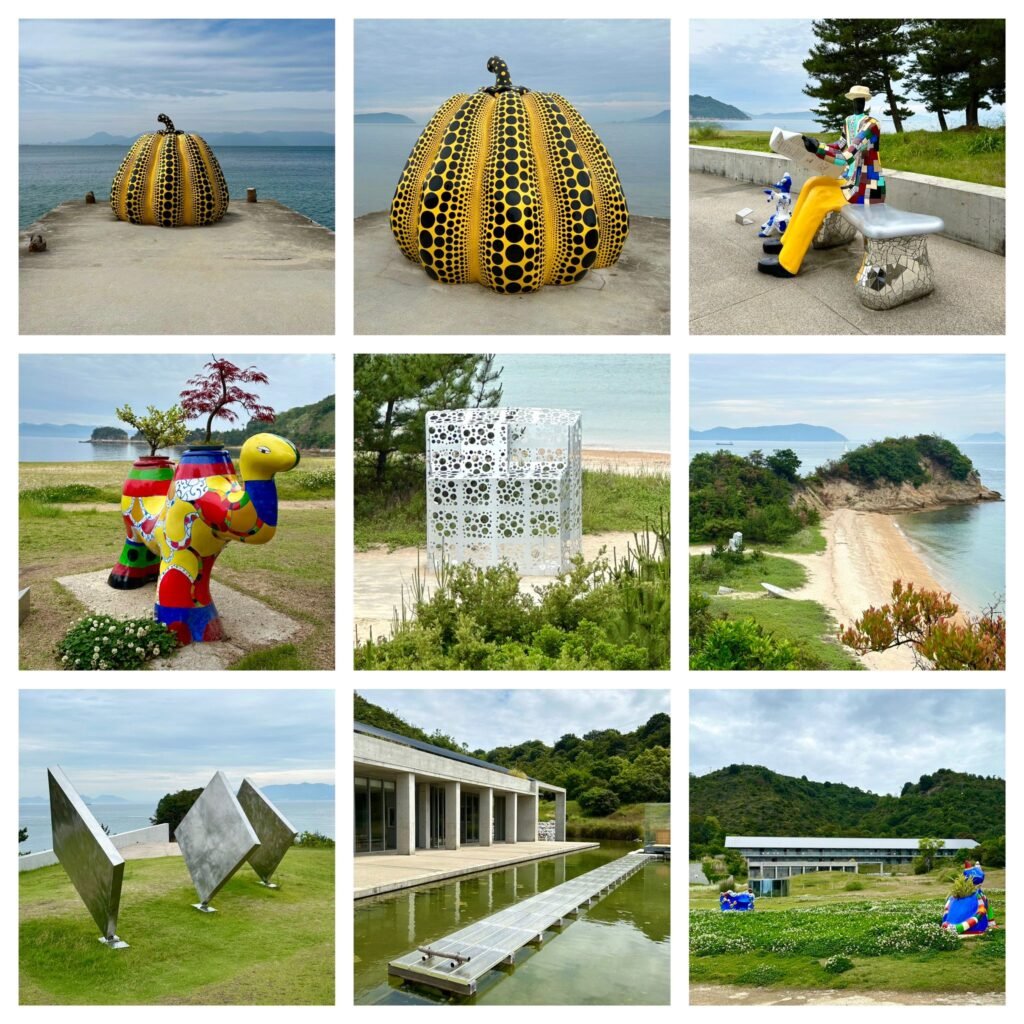
On the beach you can find the famous and iconic Yellow Pumpkin monument by Yayoi Kusama, located on a pier that extends out towards the sea. It was carried away by a typhoon in the summer of 2022 and was subsequently relocated at the beginning of 2023. The orange-haired Japanese artist, who has become a cult figure thanks to her eccentricities, has distinguished herself through an art that she defines as psychosomatic, an art that allows her own hallucinations to run free, repeating joyful, playful and colorful figures and motifs. The giant pumpkins with polka dots and the horizons of obsessive points are both naive and poetic; they are emblematic of a work that is resolutely psychedelic. Since childhood, Yayoi Kusama has been completely obsessed with polka dots: «My life is a polka dot among thousands of other polka dots,» she repeats to define her artistic gesture. Born in 1929, she turned to art despite an authoritarian family environment in Japan, before leaving for the United States in 1957 where she was supported by the American artist Georgia O’Keeffe. After this hiatus overseas, she lived, since her return to Japan in 1977 and at her request, in a psychiatric facility, only leaving to work in her studio.

The sculpture park and the Benesse Museum.
In the park of the Benesse hotel with its sea view, sculptures by Niki de Saint Phalle and Karel Appel brighten up the waterfront. Inside the hotel, a large gallery space hosts temporary exhibitions. During our visit, the Japanese artist Hiroshi Sugimoto was in the spotlight, with works in black and white and glass sculptures with spiritual Japanese lines. Hiroshi Sugimoto is also featured in the Benesse Art Site’s permanent collections, as at Château La Coste, where his work in polished stainless steel rises up at the entrance of the art center, evoking the concept of infinity. Sugimoto, who is also an architect, is part of the artists close to Tadao Ando and both, each with their own material, are engaged in a research on the dialectic of shadow and light. Tadao Ando often emphasizes that in Japan, shadow is essential and dusk is traditionally preferred to dawn. While Sugimoto is known for his conceptual photographs, particularly his seascapes series, his art marked by technical and intellectual rigor is expressed through a variety of media that explore the interplay between line and light. He tirelessly observes shadows, from different angles and in different temporalities: «In the morning light, the shadows play freely on the surfaces; they appear and then disappear. On rainy days they take on a more intense and evocative appearance. I have only just begun my observations, but I have already discovered an extraordinary variety of shades of shadows,» he declared a few years ago when he initiated a new artistic project.
In the corridors of the Benesse Hotel, you can also find sculptures by Anthony Gormley and an installation of stars in the sky by Teresita Fernandez, along the archway leading from the lobby to the restaurant terrace. A few steps from the main building of the hotel, the Benesse Museum in a concrete rotunda designed by Tadao Ando (which has a few rooms for a night of total museum immersion) features works by Cesar, Giacometti, Basquiat, a very Instagram-worthy light installation by Bruce Nauman (One Hundred Live and Die in neon), paintings by David Hockney, Elmgreen & Dragset, stone circles by Richard Long, a sculpture by Joel Shapiro and works by remarkable emerging Japanese artists.

The Chichu Museum: architecture designed by Tadao Ando as a showcase for the works of James Turrell, Walter de Maria and... Monet.
Tadao Ando designed the buildings of the new museums that have been added to the Benesse Art Site over time. The Chichu Museum, built in 2004, houses a small number of monumental works. The architect designed bespoke installations: three autonomous spaces are connected by networks of bridges and concrete corridors. Ando collaborated with James Turrell on the structure for his Open Sky and its immersions in light; he conceived a vast staircase for the arrangement of the works by Walter De Maria; and he worked on a room for Monet with a floor made of 70,000 tiles of raw marble, which can be entered in slippers to admire the Nymphs and The Pond of the Nymphs. The presence of Monet stands out against the island’s contemporary approach, but it is a moment of visit that evokes a near silence among the Japanese.

The Lee Ufan Museum and its radical minimalism are next to the Narcissus Garden by Yayoi Kusama.
In 2010, Tadao Ando built a museum dedicated to his friend the Korean artist Lee Ufan: an area where one finds outdoor installations such as the arch that opens onto the Seto Sea and the arrangements of rocks. Inside the pictorial works as well as the sculptures and installations that celebrate the void, in the radical minimalist spirit of the Mono-Ha movement (in some respects similar to the Arte Povera of Giuseppe Penone), the natural material (stone, wood) is used. A friendship and a closeness of purist lines, emphasizing the harmony between nature, raw art and architecture unite these two conceptual artists: an invitation to silence.
The Valley Gallery is a garden around a pond where Yayoi Kusama has installed a work from one of her emblematic series: the Narcissus Garden, mirrored spheres on the water or in the perspectives of a building also designed by Tadao Ando.

Art to discover in all its forms and across the entire island of Naoshima.
The Art House Projects, located in Honmura Port on the island, consist of seven traditional wooden houses that have been commissioned by Japanese artists or groups of artists for installations. They surround the Tadao Ando Museum, another wooden house that opens onto an interior of concrete and light perspectives, where the drawings of the various projects carried out by the architect are listed.
A multitude of outdoor works punctuate the walk around the island, along small forest paths by the sea or on a hill: the yellow and red pumpkins of Yayoi Kusama, the three large metal spheres in the wind by George Rickey, the stone spheres Seen / Unseen / Known / Unknown by Walter de Maria, the hybrid animals of Niki de Saint Phalle or Karel Appel, the giant Cup of Tea by Kazuo Katase, or works by Anthony Caro, Dan Graham, Shinro Otake, Hiroshi Sugimoto, Kimiyo Mishima…
Getting around on Naoshima.
The setting of Naoshima is idyllic, between the sea and the pine forest, perfect for one or two days dedicated to art and architecture. In addition to the hotel shuttle that travels the island (be sure to take the timetable), local buses from Naoshima take visitors from one point to another (plan to have some small change to pay the 150 yen ride). From the Benesse Park Beach Hotel to the Benesse Museum, it is a 10-minute walk and another 10 minutes to the Lee Ufan Museum and Valley Gallery, adding another 10 minutes to the Chichu Museum. Reservations for the Chichu Museum are required in advance on the website as the number of visitors is very limited. On the day of the visit, it is sometimes possible to adjust the schedule if there are still seats available. To get from the Benesse Art Site to the Tadao Ando Museum and the Art House project, it is best to take the bus (10 minutes – the walk takes 30 minutes but it is not the most pleasant way to get around the island).
A visit to Naoshima should be complemented by a trip to the neighboring island of Teshima.
Si Naoshima means «the pleasant island» in Japanese, Teshima can be translated as «the prosperous island» because the production of ornamental stones has long been a source of wealth for its inhabitants. Few ferries allow for a direct journey between Naoshima and the neighboring island of Teshima without passing through the port of Uno on the coast. The Teshima Art Museum offers an unprecedented conceptual and sensory experience. Created by Ryue Nishizawa, the museum reveals itself as a concrete drop, open like a crater at the summit of a hill of terraced rice fields. This space is actually a work in itself, an immersive work rather than a museum, since it houses only a single installation: the Matrix by the artist Rei Naito. The atmosphere changes constantly under the effects of water and light, but also depending on the natural environment outside. We step out to enter, silence is required and photography is prohibited so as not to disturb the experience and open all our senses to poetry and beauty.
The archives of Christian Boltanski's heart on the island of Teshima.
Also found on this island of Teshima in a small black wooden house is the museum that houses the heartbeats collected by Christian Boltanski from volunteers from all over the world who wished to participate in the experiment and donate the sound of their heartbeats. Boltanski presents these beats in synchronization with light projections so that the visual rhythm is connected to the sound rhythm. A screen at the entrance indicates to which person the beats belong, whether anonymous or not. This sensitive and poetic approach embodying universal fragility has deeply touched the souls of the Japanese who have devoted a true cult to the recently deceased French artist. Christian Boltanski also created another work on the island of Teshima, in the forest, around the sounds emitted by the wind.
To visit the island of Teshima in addition to that of Naoshima, it is ideal to spend two nights on Naoshima and travel the next day after the first night on Teshima by the 9:20 am ferry).
If these two artistic destinations are on your list for your next getaway, do not hesitate to contact us and we will be happy to share our advice and experiences.