
Bernar Venet currently lives in Muy (Var) in the conceptual art foundation he created in 2014, around a 16th-century windmill purchased in 1989, the epicenter of a sculpture park and an art gallery. A return to Provençal roots for the son of a schoolteacher from Château-Arnoux, who arrived in Nice in the 1960s, for an artistic journey that would lead him a few years later to settle in New York. In 1966, a first stay at Arman’s invitation was the prelude to more than half a century of life beyond the Atlantic.
New York and the avant-garde of minimalist art
In these 1960s, when narrative figuration takes center stage, with the enthusiasm for Pop Art and the new realism brought by the Nice School, Bernar Venet stands out for his quest for an aesthetic, conceptual, mathematical and industrial language, through paintings of a radicality that stands just as much in contrast to figuration as to abstraction. His artistic creations could be considered the translation of a linguistic project inherited from the Galilean idea of mathesis universalis. A truth that is understood as the accuracy of representation, that is, the conceptual adjustment to the result of a numerically validated experience. This truth is grasped through the formal language of nomenclature referring to the object.
This radicalism led Bernar Venet to engage in decisive encounters with artists such as Donald Judd, Sol Lewitt and other figures who were part of the avant-garde of minimalist art. In the artistic frenzy of New York in the 1970s, he also exchanged ideas with Andy Warhol and Roy Lichtenstein and questioned his practice and his uniqueness within contemporary creation in the midst of constant change. A first sculpture, Les Tubes, prefigured an evolution towards line and arc, which he applied both in his paintings and in his experience with sculpted material. This evolution was confirmed in the second half of the 1970s, while in the meantime he ceased his artistic practice to engage in a period of reflection during which he taught art theory at the Sorbonne.
An "objective" approach for "self-referential" sculptures"
His artistic discourse then asserts itself in an objective approach, or to do so is the essence of creation, leaving the meaning to be inferred. Bernar Venet calls his sculptures ’autoreferential,« meaning that they speak only of themselves, freed from any moral, symbolic, or utilitarian dimension. »On the level of research, there is neither desire nor value, nor good or evil, nor purpose,« the artist specifies. The work finds its intrinsic identity without any externality. A literal and objective art.
However, this approach does not involve any pre-planning or conception. On the contrary, Bernar Venet claims the unpredictability of the new forms that emerge and which he seeks to discover in a confrontation with the material’s resistant properties. «My sculptures are the story of their fabrication and the resistance of the metal. A test of strength and a battle waged between the steel bar and myself. Who does what to the other? A struggle between the artist’s will and the rigid nature of the rolled bar.» Minimalist and monumental sculptures that open him up to international acclaim.

Random Combination of Indeterminate Lines, 1991
Eleven steel bars in a random combination on a steel plate
Unique work
21 x 60 x 60 cm
The Venet Foundation in Muy
After 54 years spent in New York and achievements around the world, Bernar Venet returns to his Provence homeland. His American-registered foundation in Muy is a place that reflects his journey, woven of significant encounters with artists who have accompanied him along the way. A way to extend a hand upon his arrival in New York. In 1989, Bernar and Diane Venet bought the Moulin des Serres, a property organized around a dam on the Nartuby River. A domain rich in history and anecdotes (Jean Marais filmed a scene from The Bossu there) that was the site of the Paulvé plant that manufactured the control systems for the railways. Listed as a picturesque site, the Moulin was first owned by the Venet couple before its transformation into a Foundation became a matter of course. Two parks of monumental sculptures on both sides of the river, an exhibition gallery, and a «factory» hangar for experimentation where the artist designs his sculptures in ever more imposing dimensions, form a sublime journey of art and architecture. At once a place of leisure, a place of work and subsequently a place of exhibition, the estate has been transformed with the complicity of Didier Guichard, the architect of the Museum of Modern and Contemporary Art of Saint-Étienne, in a minimalist aesthetic.


The park of monumental sculptures
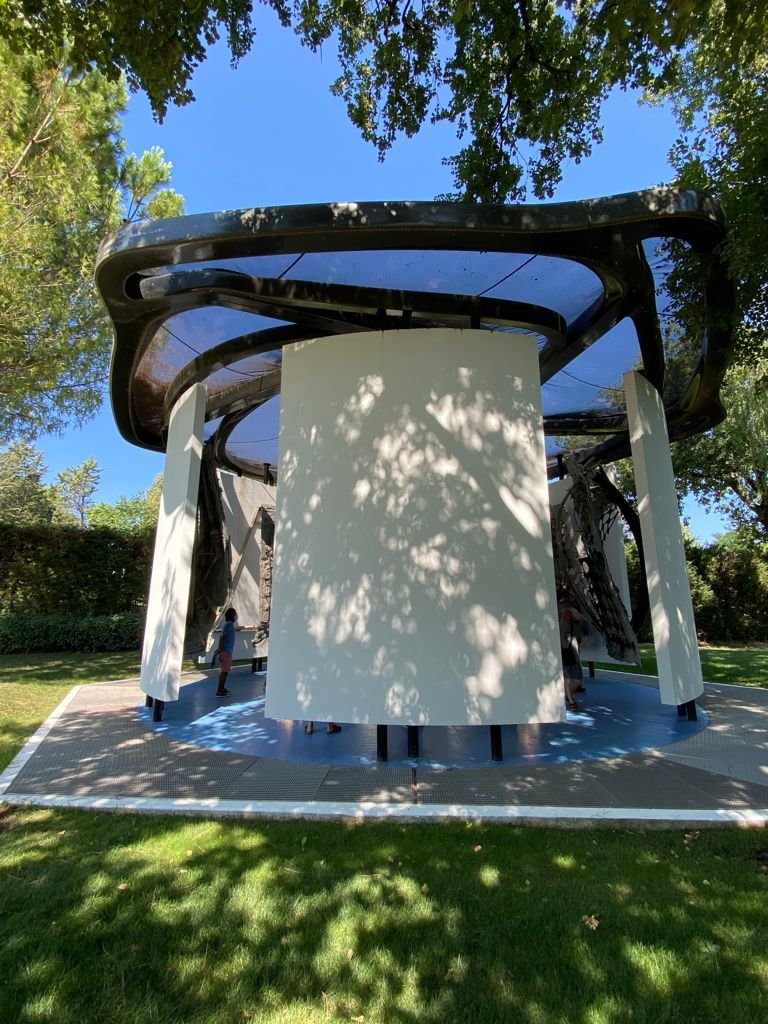
The park of the estate is dotted with conceptual works, such as the Franck Stella Chapel installed in 2016, composed of six monumental abstract reliefs in a circle measuring 15 m in diameter, a swimming pool designed by François Morellet, installations by Donald Judd, Sol Lewitt, Dan Flavin, Robert Motherwell, Richard Long, Robert Morris, Kenneth Noland, Anish Kapoor or more recently Laurence Wiener.
The foundation can be visited on certain days by reservation during the summer season (guided tour only). A must-see during a stay in the region. The Foundation is one of those places dedicated to art in privileged locations, reminding us that artifice, the built, aesthetics and architecture are the defining features of civilized man.


James Turrell at the Venice Foundation
During the visit to the Venet Foundation, one can experience the immersive experience of James Turrell’s work. Elliptic, Ecliptic is one of the installations in the Skyspaces series by James Turrell. There are dozens of them around the world. Inside this ovoid building that has found its place in the sculpture park of the Venet Foundation, the viewer is invited to sit down to observe the sky through a narrow space. The inspiring source of these skyspaces is the Roden Crater volcano. After receiving a Guggenheim Prize, James Turrell flew over the western United States for seven months, and the sky became his studio. Above the Painted Desert in Arizona, he discovered the Roden Crater: an extinct volcano that has been known for 400,000 years and is also known as the former Hopi reservation. Located at an altitude of 1600 meters, its height of 200 meters offers a magnificent spectacle. After years of work, topographical surveys, aerial views, and preliminary drawings, the artist has acquired this space and, for more than 45 years, has been developing his project of a land art monument. The Roden Crater is finally set to open in 2023 to welcome the public, as well as 21 visualization spaces and six tunnels that will restore the light and image of the stars throughout the hours of the day. A unique sensory and immersive experience dedicated to contemplating light.

Monumental sculptures in Nice
While in Nice, a city where his talent could emerge and which he wished to honor, Bernar Venet donated a monumental sculpture erected in 2010 to celebrate the 150th anniversary of the annexation of the Niçois county to France. The «9 oblique lines,» like an obelisk on the Promenade des Anglais, constitute the tallest and heaviest public work in France. On the Promenade du Paillon and its recently redesigned Albert 1st Garden, one can admire another monumental and emblematic work: The Arc de 115.5 degrees. This 115.5-degree curve corresponds exactly to the curvature of the Bay of Angels.
Collapse, an evolving sculpture
In 2011, the artist, invited to Versailles, installed his work titled « Effondrement ». One of the 7 monumental works presented on this occasion. A dialectic between order and disorder inspired by chaos theories. 160 tons of Corten steel beams were thrown onto the ground. Arcs and undefined lines redraw the landscape of the royal gardens during this exhibition. At Muy, Effondrement becomes an evolving work; the accumulation of 150 tons of beams in 2014 increased to 200 tons of steel in 2016.
The Grand Arc, the extravagance in the project
In 2019, after 35 years of waiting and several unsuccessful attempts in France, Bernar Venet installed his Arc Majeur on a Belgian highway near Lavaux Sainte-Anne. 60 m high, 75 m in diameter, 250 tonnes, 12,000 hours of welding and assembly. The work is unveiled while one is moving during a journey, offering a completely unique and unexpected perspective on sculpture. An unprecedented way of approaching sculpture.
An artist who always pushes the boundaries of the monumental
One of Bernar Venet’s projects is the design of an 80-meter-high, straight-line sculpture symbolizing an orchestra baton, as a way for the artist to pay tribute to Herbert von Karajan on the occasion of the centennial of the Salzburg Festival of popular music and theater. And among the artist’s wildest dreams is the realization of Grandes diagonales, which would involve several straight-line sculptures crossing the planet and virtually connecting the main capitals of the five continents. At a time when the pandemic condemns us to a retreat into ourselves, this sculpture deployed on a global scale could well signal a link to be rebuilt.

The gravity hypothesis, exposure at the Louvre Lens
Meanwhile, after a major retrospective at MAC Lyon in 2018-2019, the Louvre Lens will host and highlight Bernar Venet starting this summer, from June 14, 2021 to January 31, 2022. Entitled Bernar Venet, L’hypothèse de la gravité, the exhibition will highlight monumental works that explore phenomena related to physical laws faced by matter. Two works were presented as part of the exhibition Soleils Noirs last year, which in a sense provides a prelude to this search for gravity in the artistic gesture: Macadam and Tas de charbon, two installations in which the artist questions the matter of black color. Macadam is a monochrome surface obtained by pouring hot bitumen onto the support, with the flow playing a law of gravity with the industrial material that replaces the paint. In Tas de charbon, gravity defines the fall and movement of the coal, a work that finds a particular resonance in the former mining basin of the North. Therefore, there are many exciting prospects ahead regarding the deployment of this work by this indispensable artist. There are many outdoor installations to discover during outings; a summer visit to the Fondation Venet au Muy is a must on the agenda for outings in the south of France, and the Louvre Lens exhibition is a must this autumn.
Hatchikian Gallery presents 5 works by Bernar Venet
While spectacular monumental sculptures are emblematic of Bernar Venet’s aesthetic research, the artist regularly creates smaller formats, whether in paintings or sculptures. Hatchikian Gallery presents 5 works available in its collections: three works from the series Random Combination of Indeterminate Lines, created in 1992, 1993 and 1995 using mixed techniques of oil stick, graphite and collage on canvas, as well as two sculptures: Random Combination of Indeterminate Lines, a unique work in steel from 1991, and Untitled, a bronze sculpture from 1993. We are at your disposal to introduce you to these works and provide you with all the information you may need about them.

Random Combination of Indeterminate Lines, 1993
Pastel gris, graphite and collage on mounted paper on canvas
Work signed and dated
H150.5 x L198.5 cm