

As an indefatigable aesthete, Pol Quadens draws the contours of a world where the «commodity,» the fetish of transactional ugliness, has been eliminated, ousted by the beauty of the object. As Kant wrote to set limits to extensive commodification, «Everything either has a price or has dignity,» Pol Quadens might say «either a price or a beauty.» Sublimating matter is a drive that comes from his childhood, a way of entering the world, becoming a man, in the transmission of a pride to conceive and manufacture beautiful objects irreducible to their function. Born in 1960 in Brussels, he is the author of a work whose culmination reconciles design and art.
The technè, a resource for the imagination.
The initiation to creative know-how could take place in the personal workshop of an industrial father who was passionate about the artisanal manipulation and imaginative use of materials with diverse properties, opening up a field of possibilities in terms of the functionality or design of objects. But why reduce the object that bears the imprint of a human gesture to its sole utility? How could aesthetics define the object worthy of being considered outside the realm of the commodity that is consumed and consumed itself? Imagination always needs to be set in motion by constraints and resistances. The knowledge that Pol Quadens has been able to build up regarding the technicality of materials is rooted in what the ancient Greeks called technè, a knowledge articulated to a thought that interweaves material and immaterial dimensions: a knowledge that becomes a valuable resource for experimenting, transforming, and sublimating.
The philosophical foundation of creation.
At fifteen years old, Pol Quadens continued his training in a renowned art school in Brussels, and it was another tutelary figure who opened him up to a field of decisive emotions: Pierre Sterckx’s teaching was a true revelation at a time when one seeks to place one’s subjectivity within a common world that is both grandiose and a source of disillusionment. The art critic not only discovered the works of museums and contemporary creation; he is also a writer who questions aesthetics through the prism of the pleasure of the text, through the energy of words. This is an initiation into artistic eclecticism as well as into the foundational writings of literature and philosophy that will profoundly mark Pol Quadens’ path. This philosophical foundation of knowledge will nourish his relationship with aesthetics and preserve it from the contemporary illusions brought about by the rise of a procedural and instrumental ideal, at the risk of a reification of Man, the deadly effects of which we can fear – History teaches us this.
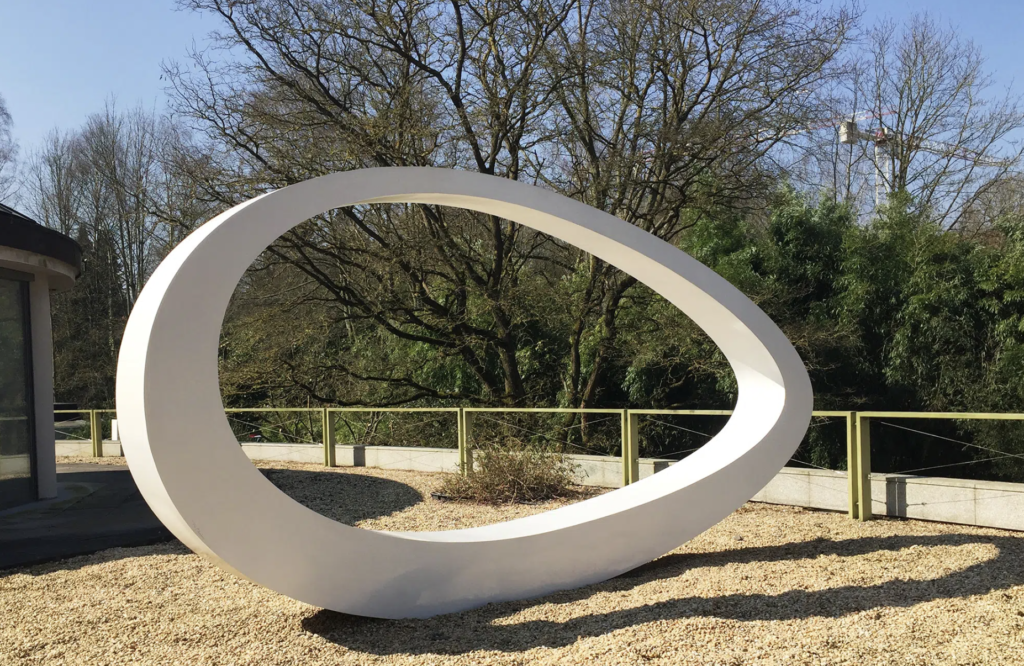
OVOID, 2014
Steel
H250 x 500 – 45 cm
8 copies + 4 E/A
The shaping of matter and thought.
At seventeen, forced to end his artistic studies to work, Pol Quadens restored old cars and learned bodywork from a garage mechanic. In a way, the elements of a biography are never as disparate as they may appear when they do come to light. The work of shaping the material and drawing beautiful lines is the essence of this technical and gestural skill that Pol Quadens will open up to creativity. He does not abandon the impetus inspired by Pierre Sterckx and continues his reading, to confront the foundational texts and the great figures of philosophy. The structuralist approach appears to him as a point of support for illuminating a critical relationship with the world, for putting into perspective the alienation of man confronted with a form of insatiable frenzy that thrives on the mirage of consumerism to fill this lack-of-being that nevertheless makes us present to existence and desire. Philosophy will thus remain inseparable from his aesthetic quest, which he unfolds in design or in art.
Lines of bold simplicity for remarkable design pieces.
Pol Quadens, thanks to his experience in car bodywork, will gain his independence by opening his own garage. This will be an activity he will carry out for a good decade, without abandoning his exploration of the trajectory of civilization through the history of thought. In this intellectual journey, he aims to find lines, continuities, oppositions, breaking points, and inflection points: a form of relationship with the world. The line is what structures a discourse, whether philosophical or aesthetic, as an allegory of existence. Drawing, which is tied to the idea, is essential to the creative process and allows one to work on that characteristic of the line. It is the impetus, the opening, that connects without locking in. Pol Quadens draws objects with unique, singular, and unexpected lines in a purity that never borders on austerity. Restaurant les voitures d’exception, he comes into contact with enthusiasts of beautiful objects and collectors: these are all the links that weave these invisible lines that are the high tension of audacity. Pol Quadens designs a chair, has it manufactured; a design gallery exhibits it; aestheticians acclaim it. He designs a shelf to store the first compact discs that transform sound; a shelf that has become an iconic piece of furniture, sold in more than 100,000 copies. In the design galleries of Brussels, the furniture bearing Pol Quadens’ signature gains notoriety, achieves success, and this is the beginning of a fifteen-year adventure dedicated to creating collection pieces that sell in substantial series.

16 STONES, 2018
Stainless steel
H450 cm
Unique work
Innovative materials for a creative game between gravity and lightness.
The experimentation in the field of possibilities opened up by composite materials multiplies the creative applications. The design of a chair made of carbon fiber defies the laws of gravity with its insolent lightness. Travel nourishes inspiration and provokes encounters. In Italy, a country of fashion and design par excellence, Pol Quadens stands out at the beginning of the 21st century thanks to a quirk: the «Strada» shoe made of carbon fiber, plays on the paradox between the resistance and lightness of the revolutionary material to eliminate the heel, retaining in a duality between the visible and the invisible only the curvature of an elegant line. Succeeded by Madonna, this feat of style for a weightless approach is produced in more than 5000 copies in two years, available in shades of colors and renewed in different finishes. But style itself is not in itself a stimulating direction for Pol Quadens’s thinking, whose purist approach stands precisely apart from contemporary fads. Although his watches, designed especially for the Swatch group, will be a success as shoes, the frenzy and enthusiasm that drive production to record volumes reveal an inevitable contradiction with a approach that remains that of a free author with a unique and unashamed creative message.
Growing international recognition, with original design pieces.
Starting in the early 2010s, Pol Quadens returned to designing pieces for limited-edition collections or projects. Meanwhile, he worked with a composite material with astonishing handling properties: Corian, which allows, through thermoforming, to push the boundaries of imagination ever further for playful lines and undulating curves. From furniture silhouettes to free-form forms, Pol Quadens« creations constitute a disruptive range in design. During this period, the designer worked for renowned decorators and began exhibiting regularly in design galleries. The solo show »Ghosts of Furniture” at the Galerie du Passage in Paris, in particular, was a success and confirmed a reputation that is expanding internationally. The Pol Quadens pieces are presented in London and New York; he creates, at the request of Jacques Grange, a table in black and white Corian for the lobby of the Mark Hotel in Manhattan. Orders follow one after another, as do sales of original pieces at auction houses, notably Pierre Bergé & associés, Piasa, Christie’s London and Bonhams, which include Pol Quadens in their catalogues.
A desire to create as an author.
These experiences have given Pol Quadens a deep understanding of materials and a recognition among collectors; however, it is not towards media exposure and business that his desire leads him. And finally, having proven himself offers, provided one does not give in to the compromises of flattery and the comfort of success, the freedom to create as an author. It certainly is not a matter of denying the achievements, but rather, in honoring his symbolic debt, to take the first step as the author. Creating with the essence of an imagination nurtured by his relationship with civilization, his reading of the world and his lucidity, as well as his dreams. Pol Quadens writes as much as he creates and conceives. Becoming an author is a long journey that requires one never to turn away from the confrontation with the «disturbances of thought and the pain of living.» Freedom is an artist’s ordeal that never settles for tranquility.

FLINT VIII, 2024
Polished stainless steel
H40 x 20 – 8 cm
Unique work
Art to overcome dualities and weave together contradictions.
The experiments with Corian have saturated the possibilities, but the limit of resistance has highlighted what ultimately constitutes the irreducible impossible, the origin of a renewed creative impulse. Pol Quadens« questioning focuses on the dialectical duality of balance and imbalance. Between the closed reasons for stability and the vitality of uncertainty, it is a matter of exploring, like a tightrope walker, this eminently living restlessness that opens the way for the emergence of a fleeting aesthetic perfection. The artist must take their chances, deal with the unresolved. Search in the paradoxes and asymmetries, the interplay of gravity and lightness, the lines and their breaking points, the becoming of a material to be thought about. The artistic language is being developed and, from design, Pol Quadens naturally turns to sculpture. A return to steel, to the act of polishing, welding, shaping, modeling, the reminiscences of the body of excellence. A continuity from craftsmanship to art. Starting in 2014, Pol Quadens» stainless steel work, polished by Pol Quadens, opens up new perspectives for unique design pieces as well as monumental sculptures for private collectors’ parks. A monograph of Pol Quadens as an artist, published in 2014 by Somogy Éditions d’Art and distributed by Flammarion, is titled “From Idea to Drawing, from Drawing to Idea.” The bond between thought and line is at the heart of the genesis of original works. The art book is prefaced by Jean-Louis Servan Schreiber, for whom Pol Quadens has created large-format sculptures.
A philosophy of sculpture initiated with the Flint series.
The sculpture offers Pol Quadens the translation and extension, in artistic lines, of his philosophical message. In a world grappling with rampant, impulsive, speculative accumulation, revealing the mechanisms of addiction on which an unlimited commodification thrives, the artist proposes to escape the alienating frenzy and to question. His series of sculptures Flint, monumental flintstones stylized in polished stainless steel, invites us to return to the creativity of the Paleolithic man with his earliest tools. The viewer confronts his own image in the dazzling mirror of the surface of these giant flintstones. A plunge into the emptiness of contemporary mass narcissism fueled by technologies with dehumanizing effects. When the tool was merely the extension of human imagination, postmodern gadgets today shape and conform Man to become the cog of an implacable digital and formal order. The aesthetics of the pure and slender lines of these brilliant silvers evoke in us the ugliness and vulgarities of the immediate. Each of us should take an introspective time before this civilizing depth that surpasses us in its signifying power. Through his monumental works installed in outdoor space, the reflection of the sculpted material finally removes the material thus rendered invisible – Pol Quadens speaks of «zero-degree material» – to better reveal its environment of beauty in variations of natural light, of days and seasons, an ode to time and vital cycles. One of the monumental sculptures by Flint, 4.50 m high, has been visible in public space on the Woluwe Boulevard in Brussels since 2020: this is the artist’s first public commission, having previously worked mainly for private collections.
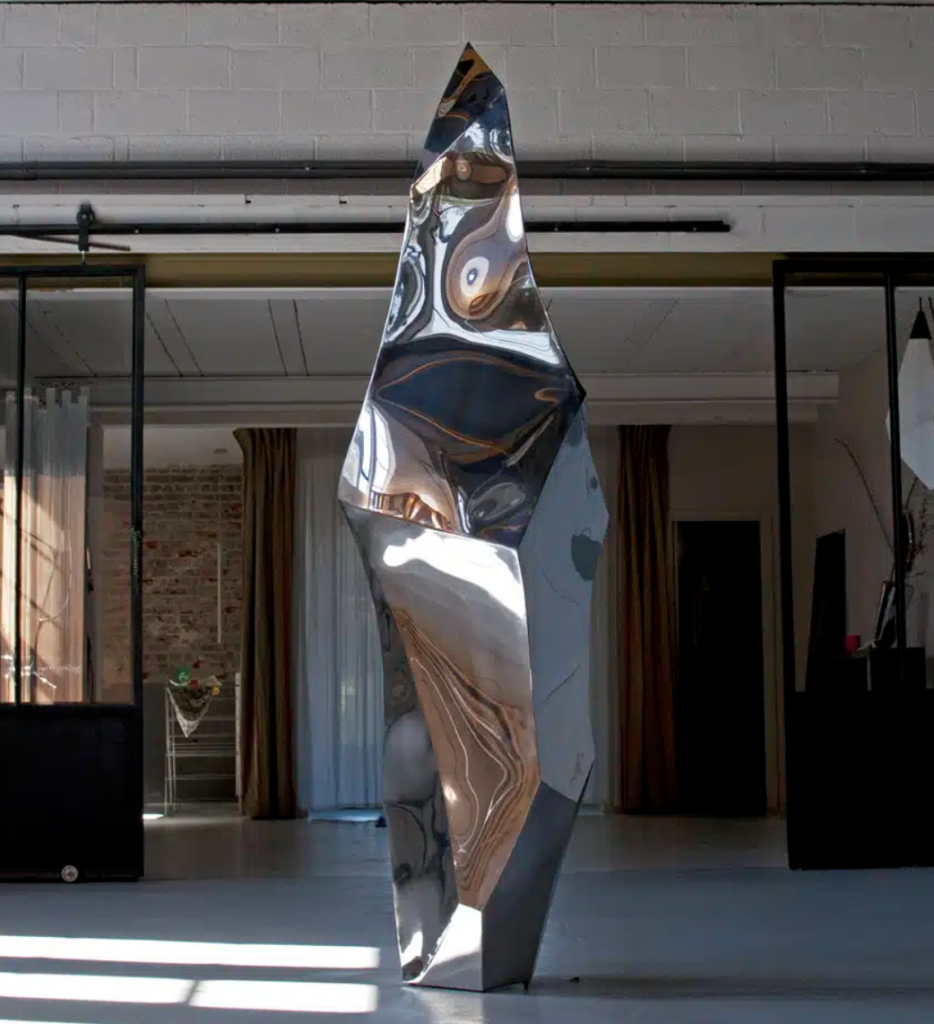
FLINT V, 2023
Polished stainless steel
H240 x 80 – 65 cm
Unique work
The Vertigo series, between design and sculpture, aims to break down categorical boundaries.
The Vertigos constitute another emblematic series in Pol Quadens’ work. These unique large-format pieces formally intertwine design and sculpture, a way of irreverence for the artist who plays with materialist utilitarianism by dragging functionalism into an artistic vertigo that confuses the perception of space, unless it is a way of desacralizing contemporary art by confronting it with an objective reason? Unclogging the paralyzing categories is also a joyful escape from the puritanism of denying the ambivalences and paradoxes that would want to obliterate any contradiction, any complexity and any human depth. The chairs and seats that make up the Vertigo series have been designed with a sensual and light touch, once again playing with the duality between static anchoring and slender movement with enchanting grace: the whirlwind of life. These Vertigos have been included in several private collections in Switzerland and Belgium.
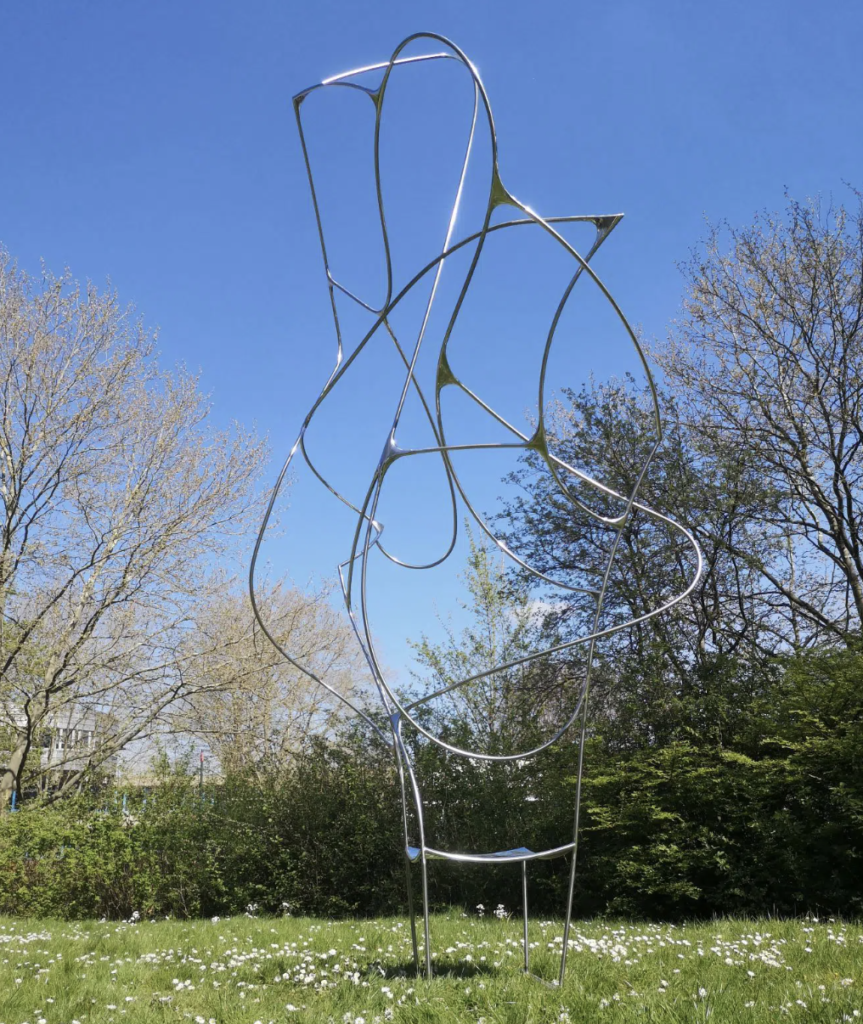
VERTIGO, 2022
Stainless steel 316
H450 x 100 x 145 cm
Unique work
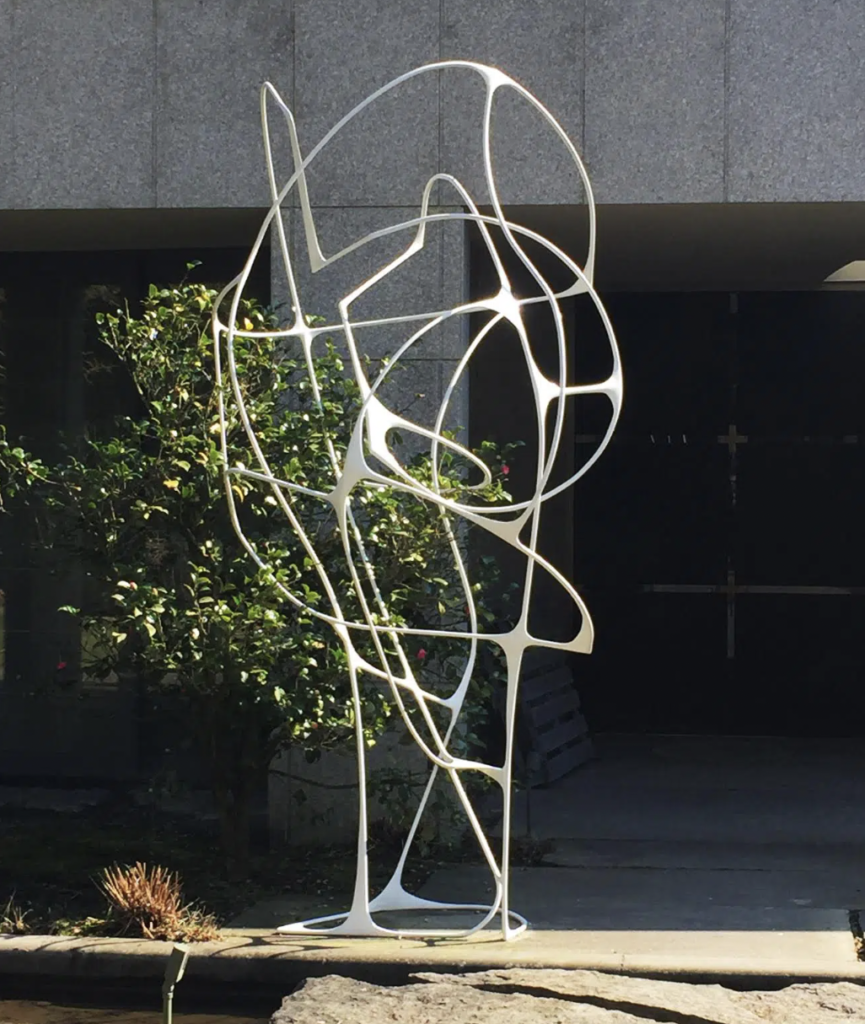
VERTIGO 3, 2015-2017
White steel, dimensions and designs variable
H250 x 400 x 160 cm
Unique work, improvisation
The Circle Bench and the sculpture Flint on a Brussels square: art to meet.
In 2022, Pol Quadens created a Circle Bench commissioned by the municipality of Woluwe-Saint-Lambert, which will be installed next to the sculpture Flint already present in the square. The circular steel bench, open in polished finish, appears, thanks to a refined and slender part, as a dynamic rotation movement that recalls those cosmic trajectories that transcend us and lead us into the mystery of origins and infinity, while the circle on which to sit connects us to the unknown, confronts us with that irreducible otherness of the face that faces us, and perhaps opens smiles and stories.
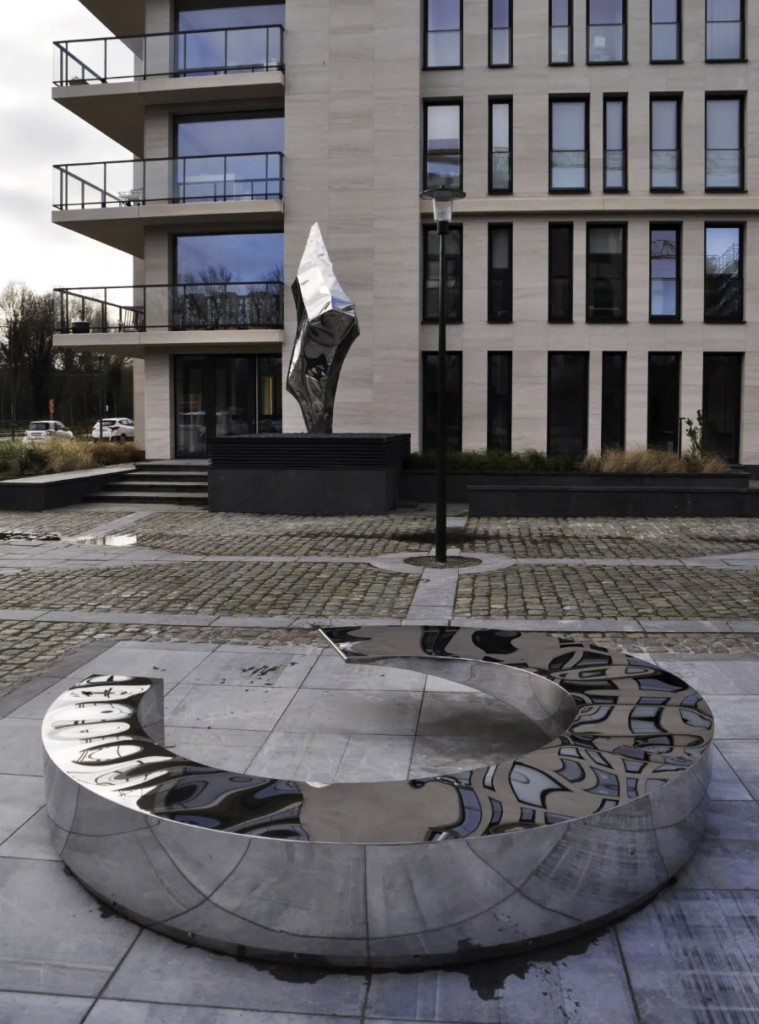
Installation in Woluwe St Lambert (Belgium)
CIRCLE BENCH, 2021
Stainless steel
H45 x 300 cm
Unique work
FLINT II, 2020
Polished stainless steel
H450 x 220 – 150 cm
Unique work
The Stones or that human question that resists.
The Stones series, inaugurated for a private collection in Switzerland by the sculpture 16 Stones, 4.50 m high and made of polished steel, is inspired by cairns, the first building of Man whose metaphorical power remains eminently contemporary. By piling stones, the cairn symbolizes the journey and its embodiment in the body: anthropomorphization recalls the living human presence that passes through a place marking an initiatic trajectory. The cairn reminds that the subjective journey proceeds from the encounter with the other through the consideration of the other, the inscription into the sense of a common world where individual history joins with universal history. The duality at the heart of Pol Quadens’ aesthetic quest is again found here in the overcoming of the contradiction that arises between the piling of forms and the minimalist purity of the sculpture.

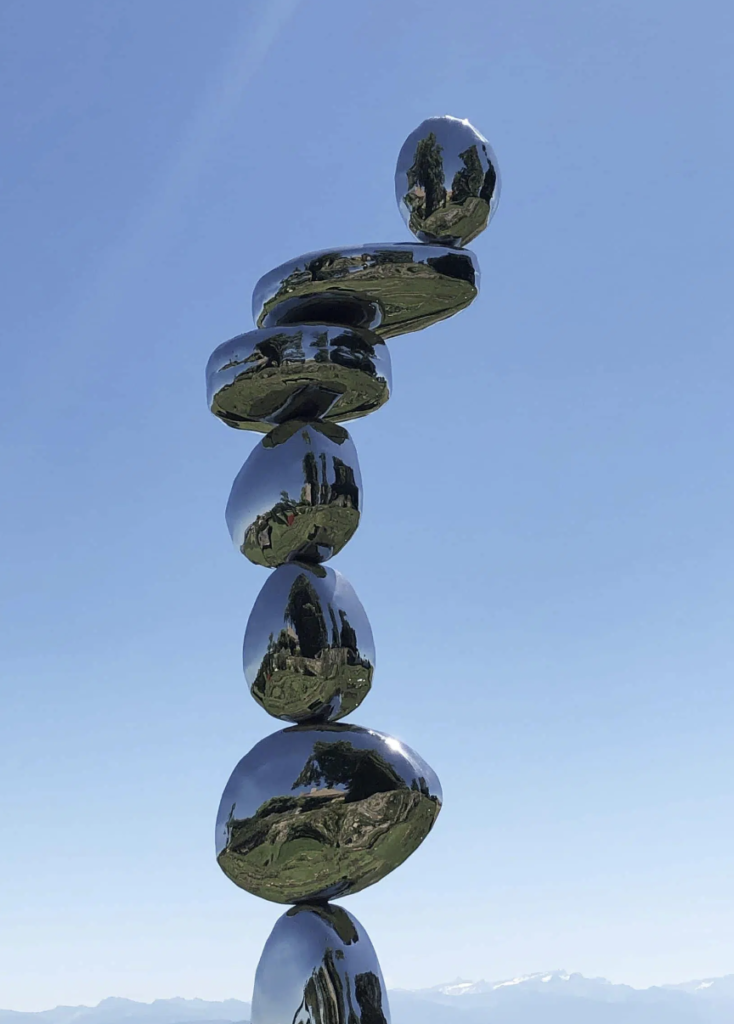
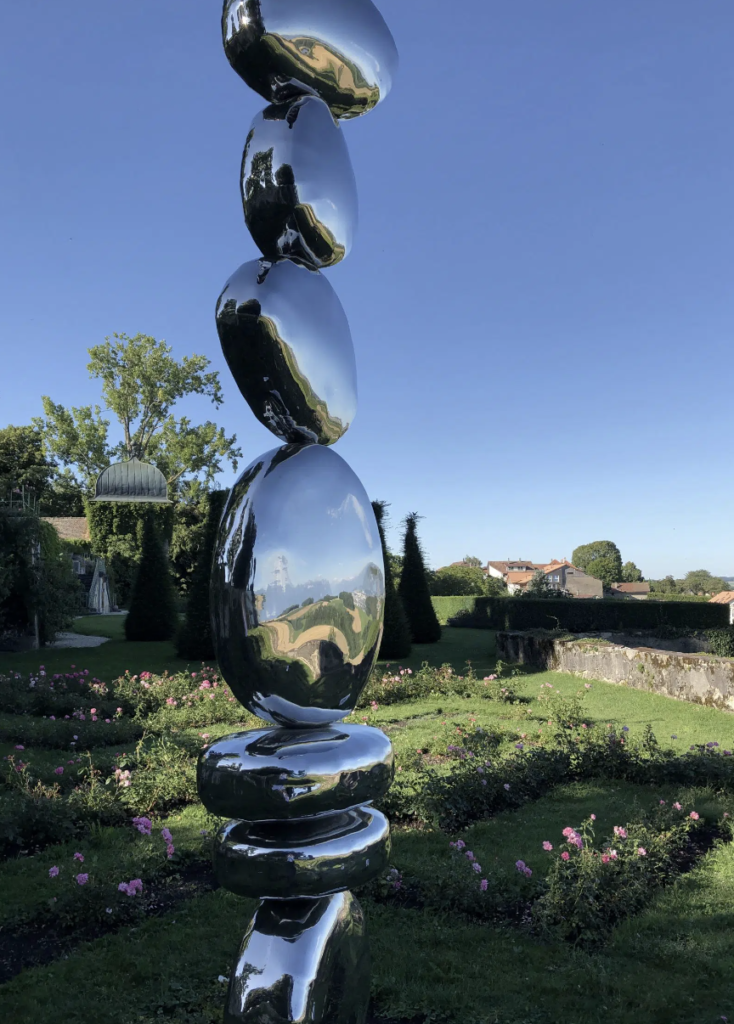
16 STONES, 2018
Stainless steel
H450 cm
Unique work
The Bench sculptures: sit down to think, sit down to get moving.
In addition to the Circle Bench, which was created as part of a public procurement in Brussels, Pol Quadens designed several Bench sculptures, including the Lockdown Bench in polished stainless steel created during the lockdown, as a giant monolith lying down, anchored in gravity, deprived of buoyancy, in a petrified world. A bench with only one seat, one bench that is private to the other. A witness to isolation or a haven of solitude? Another question arises with the Cave Bench, whose shape and volumes simulate the entrance of a cave that refers to the origins of Man but also to the Platonic allegory, more contemporary than ever, in a world where the defeat of thought consecrates the prevalence of beliefs over the demand for knowledge, a world where illusion and virtual mirages comfort the reign of the impulsive. Pol Quadens recently wrote an essay on philosophy after a long personal journey among foundational texts, reviving questions that animated humanity before the reification disqualified the symbolic order of language: questions concerning the subjective future of the human being. The work, Philosophy of Subtraction, was published in late 2023 by l’Harmattan and offers a glimpse of the path that, through aesthetics, evokes a critical resistance to post-modern alienation and impasse.
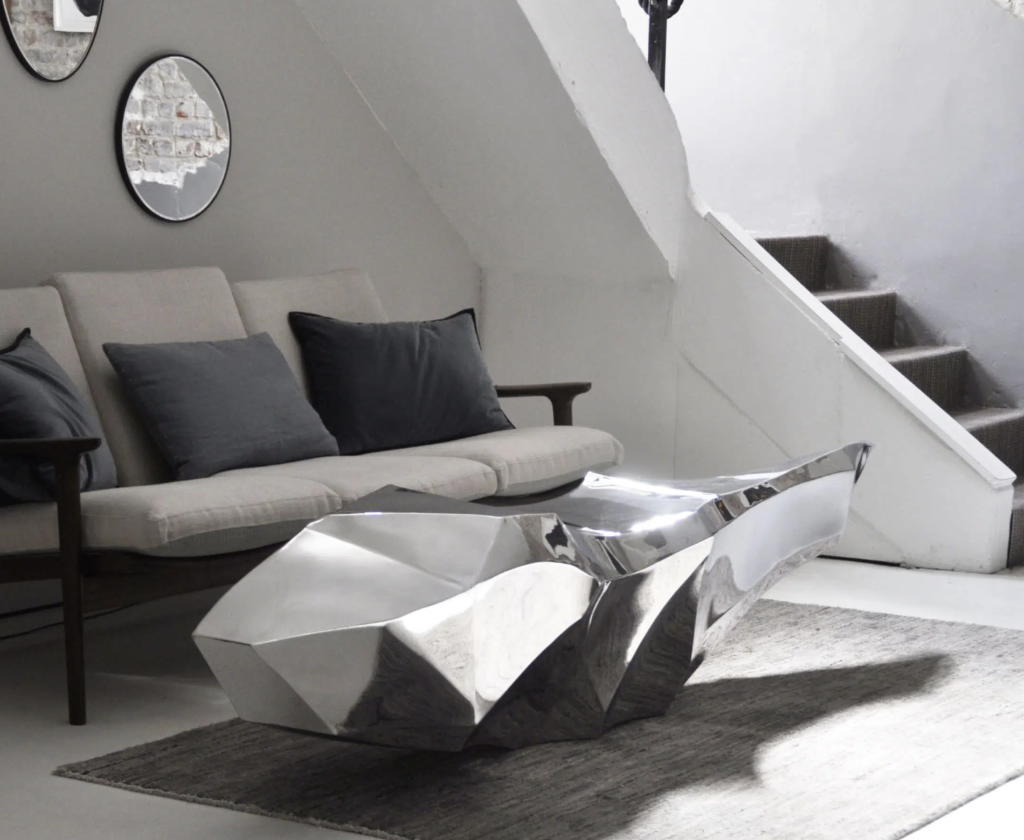
LOCKDOWN BENCH, 2020
Polished stainless steel
H42 x 222 – 50 cm
Unique work
An orientation towards smaller-sized sculptures, accompanied by the Hatchikian gallery.
The work of sculptor Pol Quadens is now unfolding in a new dimension with smaller-format pieces. A sequence that seems reversed in the context of the trajectory of most artists who tend towards the monumental, but which is hardly surprising if one takes the time to hear Pol Quadens’s message. Notably, his series of sculptures Flint, inspired by the earliest tools of humankind, is presented in a smaller size and finds its place on the intimate scale for more intimate face-to-face encounters between the work and its viewer. For the mirrored reflections in the sculptures are an invention of self-reflection. Audrey Hatchikian has the pleasure of accompanying Pol Quadens in this new direction of his work and presenting a selection of his first sculptures of a smaller size, an aesthetic material to be contemplated. The Art Loft Hatchikian Gallery lends itself particularly well to this introspective exploration, offering the interior space of a «home» whose quest is tirelessly stimulated by our relationship with beauty.
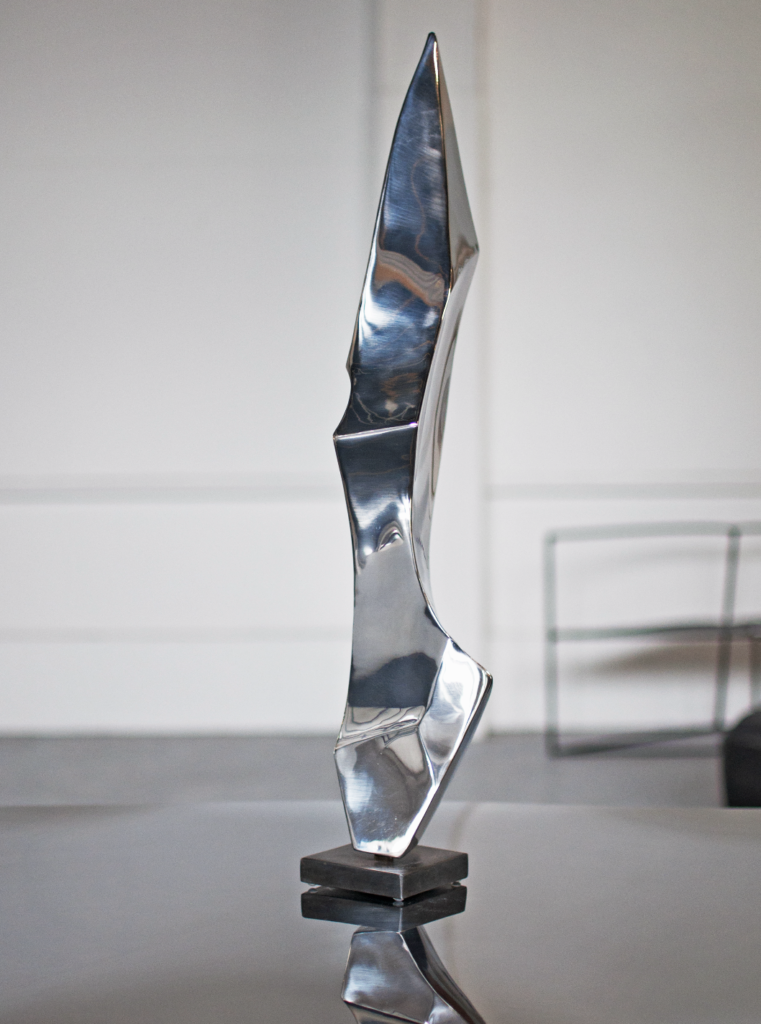
FLINT IX, 2024
Polished stainless steel
H70 x 10 – 6 cm
Unique work

FLINT VII, 2023
Polished copper
H30 x 8 – 8 cm
Unique work