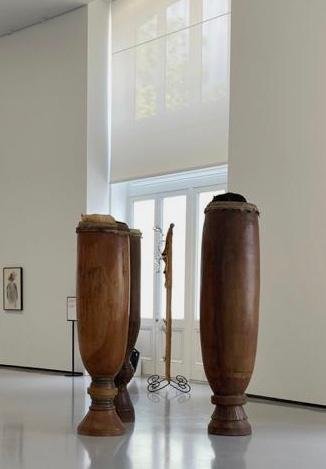

The Bourse du Commerce, a new showcase for the Pinault collection.
After Venice, it is in Paris that the works of the Pinault collection can be discovered in an exceptional setting: La Bourse de Commerce. As was the case with Le Palazzo Grassi opened in 2006 and La Punta della Dogana opened in 2009, emblematic monuments of heritage are being renovated, combining historical splendor with the contemporary architectural purity of Tadao Ando to become the settings for a scenography that confronts cultural heritage and today’s avant-garde, for a contemplation of the works in an unprecedented setting.
The Pinault collection consists of an exceptional ensemble of more than 10,000 works by nearly 350 artists from a wide variety of cultures and backgrounds, including emerging and established young talents. Paintings, sculptures, videos, photographs, sound works, installations and performances: all dimensions of contemporary art are represented. A collection that bears witness to the issues of our time and the themes that inspire creation, with approaches that are often highly engaged on political, social, racial, gender or environmental issues.

The collection is now therefore presented both in Venice and Paris in these places steeped in history, with the aim of promoting it in dynamic ways through renewed exhibitions, temporary exhibitions or off-site events, lending programs to museums or institutions. The presentations are sometimes thematic, sometimes centered on an artist very present in the collection, or in the format of blank cards offered to an artist.

The wise collector
Francois Pinault, captivated by the art of his time, inaugurated his collection by becoming interested in painting from the early 1970s, acquiring a work by Paul Sérusier, which the businessman described as the talisman of his collection. In the 1980s, François Pinault moved from modern art to contemporary art with the purchase of a work by Jeff Koons. It was then that the collection took on a spectacular scale and focused on the art of the 1960s to the present day. The collection was enriched with works by iconic artists of pop art (Rauschenberg, Warhol), then abstract art (Rothko, Pollock, De Kooning). Subsequently, there were Jeff Koons, Cy Twombly, Damien Hirst, Richard Serra, Cindy Sherman, all acquisitions that testify to the avant-garde intuition in the composition of this collection, which has become indispensable. «There are many contemporary works, perhaps a bit avant-garde, that an uninformed public will find difficult to grasp, but I hope they will try to understand them; they will try to open their minds and that will allow them to see things differently from the way the world operates, from their own lives. This is a remedy; it is the best, I believe,» François Pinault declared recently, addressing those who will be able to discover part of this collection on the occasion of the opening of the Exchange on May 22, 2021.
Brief history of the Stock Exchange
The Stock Exchange was chosen to host the Pinault collection in Paris. The building is a testament to five centuries of architectural and technical prowess. It combines the first isolated column in Paris, built in the 15th century for Catherine de Médicis« Hôtel de Soissons, with the remains of a grain hall with an impressive circular plan from the 18th century (a fascinating and radical building by Le Camus de Mézières, built in 1764 that introduced the circular plan into French architecture), covered in 1812 by a spectacular metal and glass dome (the constructive research to cover the central courtyard generated this iron and wrought-iron dome by François-Joseph Bélanger in 1910). Built in 1812, the magnificent iron-cast ribbed roof overlooks the dome. The building was reconstructed in 1889 to become the »Bourse de Commerce«. The place thus preserves the successive traces of the architectural elements left by these three major elements of the building: the Medici column, the double-arched staircase and the interior façade of the rotunda, the glass dome. In elevation as well as in plan, this succession of layers revealed by the restoration work has prompted the architects of the renovation project to imagine a dialogue between the historic building and the contemporary project. The Bourse de Commerce was restored and transformed by the Japanese architect Tadao Ando (TAAA – Tadao Ando Architect & Associates), already solicited for Punta della Dogana and Palazzo Grassi, the other two showcases of the Pinault collection in Venice, in association with the NeM / Niney and Marca Architectes agencies, and the Pierre-Antoine Gatier agency. Begun in June 2017, the work was completed in February 2020. For Tadao Ando, it was about creating a meeting between a heritage building and a contemporary architect’s gesture. »The spatial layout of the Stock Exchange is designed to provoke a tense and more subtle dialogue between the new and the old.” The purpose of this architecture was to connect the threads of time, past, present and future, as in the projects in Venice. The idea lies in the repetition of the circular shape, almost unique to Paris, that the architect will echo by inserting a 9-meter-high cylindrical concrete ring inside the central courtyard. This future exhibition space will be dedicated to the largest works. In the lateral spaces of the rotunda, curved galleries entirely dedicated to contemporary art will be arranged on three levels. The idea was to honor the memory of the city inscribed in the walls of the Stock Exchange, and to place another structure inside, modeled on a cantilevered structure. A composition that establishes a living dialogue between history and the avant-garde, creating an area full of life as a place dedicated to contemporary art should be. « At the Stock Exchange, I would like to discuss the future in the space outlined by the circle. In the zenithal light penetrating through the skylight, people glimpse hope in the circular concrete wall.. My intention is to chain together with force sequences of spaces of very varied forms resulting from the combination of the roundabout and the cylinder. The existing space and the new one create a lively place, capable of carrying the banner of urban culture for generations to come.» For Lucie Niney and Thibault Marca, partners of the NeM agency: «Today, the heart of the Stock Exchange, protected by the cylinder, is the unprecedented scene of a meeting with the works, with the artists, and with the public. The essential features of its architecture—the glass dome, the open cylinder, the disc of the promenade—form a hypnotic circular scenography that removes the visitor from their familiar surroundings to invite them to enter a new dimension.

It is in this immersive scenography that the discoveries will be made. Opening exhibitions starting May 22nd. The opening date has been repeatedly postponed due to a pandemic that will have affected many projects and robbed us of the beauty, the art that connects us, surprises us and moves us. Art has always enabled us to eliminate distances, remove barriers, open borders and broaden our horizons. The beauty, the emotion and the inspiration towards which Art leads us will certainly be valuable in getting us moving again.
Wandering through the spaces of the Stock Exchange
For the opening of the Stock Exchange, the Rotonde will host the most famous installation by Swiss artist Urs Fischer (Untiled, 2011), shown for the first time in France. This monumental work consists of sculptures made of wax that are lit on the first day of their exhibition; Untitled, 2011 depicts seven different chairs (from an African stool to a plain plastic chair to an airplane chair), which the artist’s effigy gazes at. An allegory of a civilization marked by a rapid globalization that tends to standardize the world; as it consumes more and more, the wax liquefies and the edifice reveals its fragility, between metamorphosis and impermanence, the chalice of time that is fleeing…
The new installation of an emblematic work created in 2001 by Philippe Parreno, Mont Analogue, is erected as a lighthouse on the Médicis column. A mysterious luminous code through which the artist invites us to discover the possible, invisible and intangible worlds of artistic creation, like the allegory of the irreductible quest that always remains unfinished that brings him to it.
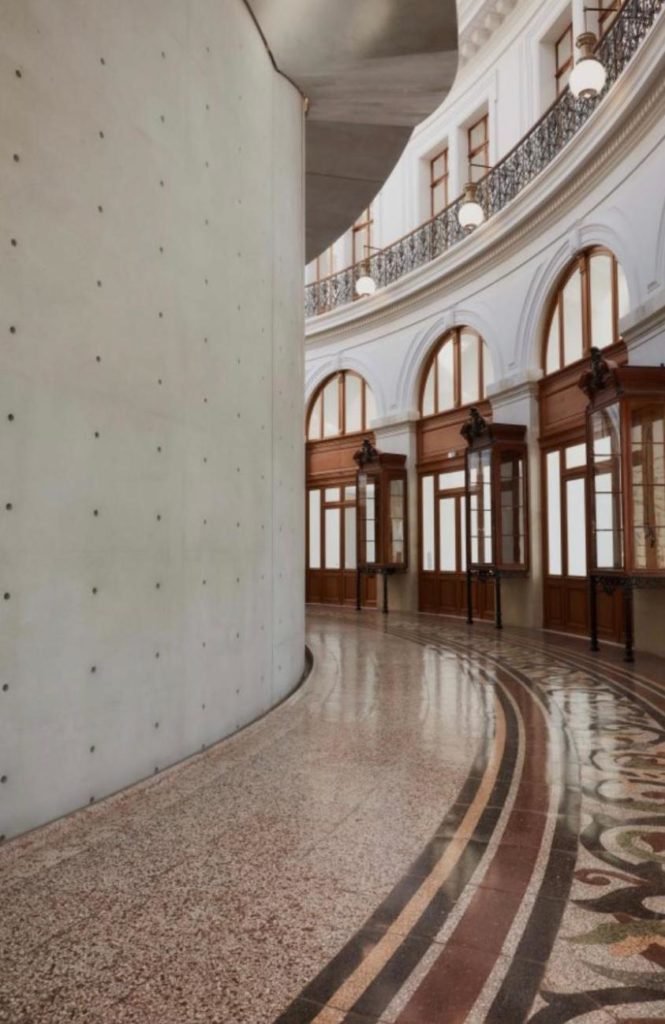
Works have been installed in situ along the circular route, testifying to the artists’ relationship with a venue of exhibition charged with history. The pigeons perched on the balustrades by Maurizio Cattelan inside the Rotonde, the animatronic mouse by Ryan Gander in front of the elevators, the dance by Lili Reynaud Dewar in the hall of the stairs, the sculpted guardians by Tatiana Trouvé—these are just some of the works that unfold an unprecedented experience for the visitor engaged in a disturbing face-to-face encounter.
When the visitor enters the salon, the first exhibition space of the trade fair, he or she discovers the work Ici Plage, comme ici bas (2012), by Martial Raysse, a large panel painted like a historical fresco with vibrant colors: an utopian and panoramic landscape between the Sainte-Victoire mountain and the coast, populated by a procession of extras, like a carnival of humanity.
In this inaugural exhibition, Rudolf Stingel presents three portraits: that of his New York gallery owner Paula Cooper, that of his friend the Austrian artist Franz West, and that of the painter Ernst Ludwig Kirchner. The artist uses small-format photographs that, enlarged, reveal the roughness and marks of time on the skin, before translating the images into painting: monumental portraits that blur the boundary between photography and painting.
Bertrand Lavier, an iconoclastic plastic artist, has transformed the «showcases,» exhibition spaces that originated from the building’s particular history, into a retrospective of offbeat and fanciful objects, ironical to the point of being wishful, blending strong colors and materials in a pop, sometimes cartoonish style.
A series of installations by the Afro-American artist David Hammons explore the themes of slavery and colonialism in the setting of restored ruins that give a particular depth to the work. A work by Tarek Atoui, The Ground – 2019, a musical sculpture for an experience, is also revealed. multisensory.
In one of the galleries, a scenography dialogues between the works of Myriam Cahn, a Swiss artist, with emblematic works by Luc Tuymans and the paintings of a young Brazilian talent, Antonio Oba.
On the second floor, the theme of the portrait unfolds through the architectural interplay of light and transparency, linking genre, origin, culture, and generation through the works of Claire Tabouret, Xinyi Cheng, Lynette Yiadom Boakye, Peter Doig, Marlene Dumas, Ser Serpas, and Kerry James Marshall.
Between photography, video and performance, the works of Michel Journiac, Martha Wilson, Sherrie Levine, Cindy Sherman, Richard Prince and Louise Lawler, artists of the Picture Generation movement, deliver experimental work that questions the status of the image in art and in society, and opens it to emerging issues surrounding identity.
In the basement of the commercial bourse, Offspring by Pierre Huygue offers a sensory and poetic event experience, a duplication that unfolds in the infinite, like a dynamic where contingent mutations occur, opening up multiple realities. Finally, the works of three artists (Martin Kippenberger, Thomas Schütte, Florian Krewer) They question the human being confronted with systems, through a practice of art that is often irreverent or scandalous and that shakes our certainties.
This inaugural exhibition reminds us that creating is a desire to make life possible. Art speaks of the ineffable. Works of art are there when our certainties waver, when time seems out of control. They do not offer a response, but open up questions and welcome our unease. Better than mathematical models in an age of fetishization of numbers, they are an invitation to be-in-the-world, to be contemporary.
«The contemporary is the one who fixes his gaze on his time and does not let himself be blinded by the lights of the century, but manages to grasp within them the part of the shadow, their dark intimacy. The contemporary is the one who perceives the darkness of his time as a matter that looks at him and constantly calls him to account, to take up the philosopher Giorgio Agamben’s reflection, in the line of Nietzsche: »The contemporary is the in-the-present.« The movements of shadows and lights are a matter that looks at Art, and that we see in the works.
The present is what remains unlived; perhaps it is then this unlived that contemporary art gives us to glimpse.