Although Pablo Zabala began drawing and painting at a very young age before freely developing his visual language in public space through the creation of graffiti and murals that quickly gained recognition, his interest in the artistic practice led him to study Fine Arts in Bilbao. In his view, an accomplished artist must humbly confront the great masters who have marked history and learn to master the techniques of classical painting in order to better forge his own unique identity. It is about inscribing oneself in the artistic common world that precedes us, whether by accepting it as a reference or proposing a path of rupture. To distinguish oneself and build one’s artistic identity does not mean erasing the past or denigrating history: let the nihilists have their illusion of their Promethean egos.
Training in pictorial technique at the Fine Arts School of Bilbao.
During these years of training in fine arts, Zabala dissociates his interest in mural intervention and the evolution of his works on canvas from the flash of the gesture and the classic realistic representation. It is only after having progressed sufficiently during this patient apprenticeship course to feel sufficiently established in his artistic legitimacy that Zabala will be able to forge closer ties between mural practice and the studio work, which will thus feed each other with their specific energies. Realism is the guiding line of Zabala’s work, and his research crystallizes on line and color, the relationship between the two constituting the original aesthetic grammar of each artist. Zabala explores chromatic nuances, developing a often cold chromaticity, with a predilection for the games of complementarity around blues.
A muralist artist inspired by the magnetism of places.
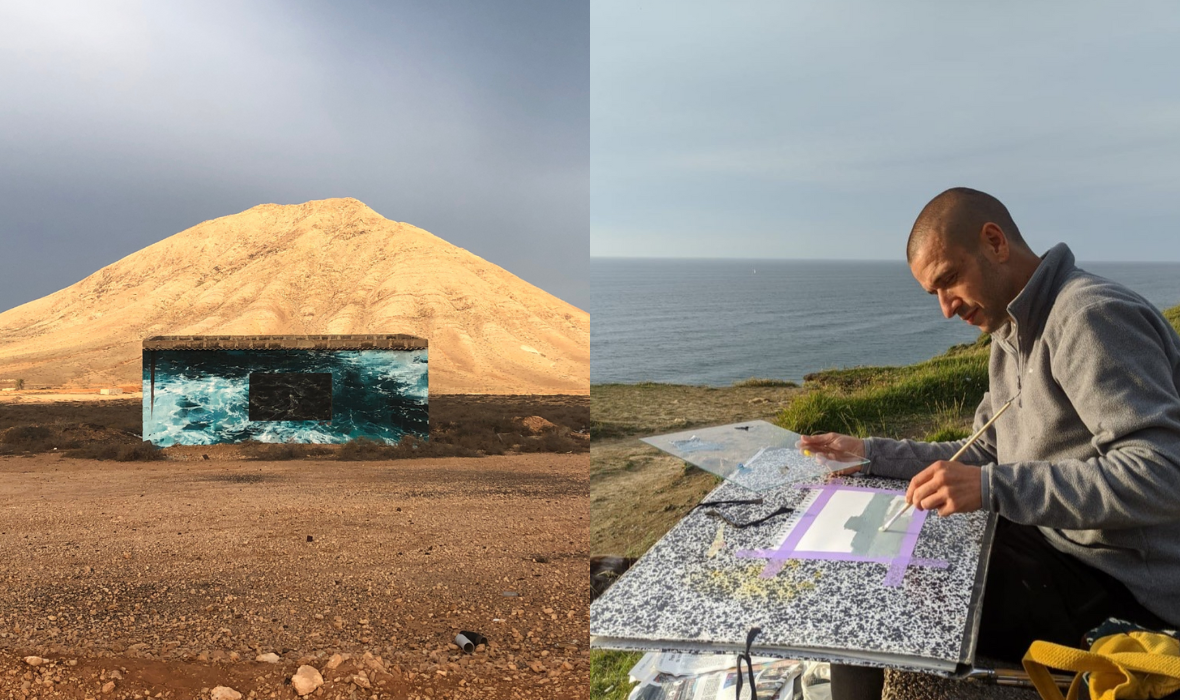
A common obsession among all urban artists does not spare Zabala: the constant quest for abandoned, steep places marked by the traces of a narrative, remarkable for the perspectives they offer, the horizons that extend them, and their irresistible magnetism—all places in transition that art can re-enchant by proposing an in-situ pictorial narrative. Zabala applies his frescoes to walls he has identified during his wanderings, and his talent also earns him numerous institutional commissions for interventions. The historical imprint of the places interests him and inspires his commitment as a muralist, with a sense of responsibility when it comes to investing a site. It could be a bridge in Biscaye, a UNESCO World Heritage Site, or even a mountain emblematic of the Canary Islands, where Zabala created a monumental mural, which is set in a place that the ancients described as a magical mountain, a natural temple where the shadows of the reliefs resembled an astronomical clock, a witness to the cycles of time passing by. Zabala introduced the element of water into the perspective of this mythical rocky landscape. The artist regularly participates in urban art festivals for which he is sought after, and sometimes creates murals with other muralists in a collaborative effort that excites him greatly for the unpredictable part that animates the genesis of the work.

Zabala joins the artists participating with Quai 36.
It was through his work as a muralist that Zabala was noticed by the art production house Quai 36 and became part of its network of participants. Indeed, Quai 36 brings together French and international artists, local authorities and elected officials, driven by the conviction that art is fully in line with the new urban planning challenges. The artists are then involved in various projects to develop innovative aesthetic proposals in connection with living together in the contemporary urban landscape, with the goal of re-enchanting the daily lives of users and residents and introducing art by stealth through the installation of ephemeral or permanent works, a way to transmit a cultural experience to the greatest number of people. A first collaborative project between Zabala and Quai 36 is in the works for a mural in a French city at the forefront of the festive events for spring 2023; a project to be followed closely as it unfolds.
An inspiration coming from the oceanic environment of the Basque Country in Spain.
Zabala grew up in the region of Vizcaya (Biscay) in the Basque Country in Spain, a province marked by a mining and industrial history, but also rich in rocky and maritime landscapes, a setting of stark contrasts between elements and a stark architecture, a chromatic universe that has particularly inspired his artistic approach. Between the emblematic city of Guernica and the contemporary Bilbao, sources of inspiration that combine history and art are not lacking for Zabala. The ocean coast is a resource for the artist who never tires of observing the movement of water hitting the rocks, the variations in color according to the climate, the changes in light throughout the day… Water will become a central theme in Zabala’s work, which often depicts this element in close-up on walls that seem to open a window onto infinite seas. This is a theme that the artist also explores in his work on canvas with series of studies, the Sea Painting, water and rocks, where the lines of movement and the nuances of blues are marked by the energy of a gripping realism, at once dreamlike, mysterious, unsettling or soothing depending on the perspective from which one looks at the work.

ROCAS 4, 2022
Oil on linen canvas
Unique work, signed
H89 x L130 cm
The movement of the water, a central element of Zabala’s work.
Pablo Zabala practices surfing every day as a meeting with this movement of the water. He experiences the topology of the waves, their kinetics, which he seeks to transcribe in his pictorial developments with this importance of the line that delineates the chromatic nuances. The artist explores inspiring landscapes: he uses photography extensively to capture forms and lights that will feed his pictorial technique. However, his practice evolves as his identity asserts itself: while he sought to represent a vision captured in flight by the lens, perfecting his realistic approach, he is increasingly freeing himself to allow imaginary compositions to take free course, always appearing realistic. Forget the image to better recreate it.

ROCAN GRAY / BLUE 1, 2022
Oil on cotton canvas
Unique work, signed
H61 x L46 cm

ROCAS GRAY / BLUE 2, 2022
Oil on paper
Unique work, signed
H60 x L45 cm
Realism in all its dimensions.
Other subjects addressed by Pablo Zabala, still in line with the realist approach, are included within figuration. For him, these themes are a pretext for a technical research that he constantly strives to achieve and renew. Thus, in Zabala’s work we find staged characters, most often in their relationship with the surrounding nature, struggling with the vital movement, or in a one-on-one confrontation with the elements. Close-up shots of contemporary characters or archetypal figures from a more ancient era are depicted.
A chromatic research nourished by mural practice and studio work.
Zabala’s works are captivating by their chromatic atmosphere; the work on color is central. A particular energy emanates from it. On the walls, Zabala paints with a quick gesture; while the work in the studio offers him the possibility of a more extended creative temporality, the act on canvas remains nevertheless inscribed within that luminosity that allows for the preservation of that part of spontaneity and unpredictability that will reveal the truth of the work. His mural works thus remain a source of vitality for the canvas. In December 2022, before the opening of the Projections group show where his work will be presented alongside those of Nelio and Chazme as part of a new collaboration between Hatchikian Gallery and Quai 36, Zabala was commissioned to create a mural in Galicia that will reveal an evocation of the forest, an opportunity for him to explore the colors, the mysteries, and the perspectives of a natural universe charged with the stories and myths that humans have been able to project there since time immemorial.

GREEN / OAK 1, 2022
Acrylic and oil on linen canvas
Unique work, signed
H70 x L66 cm
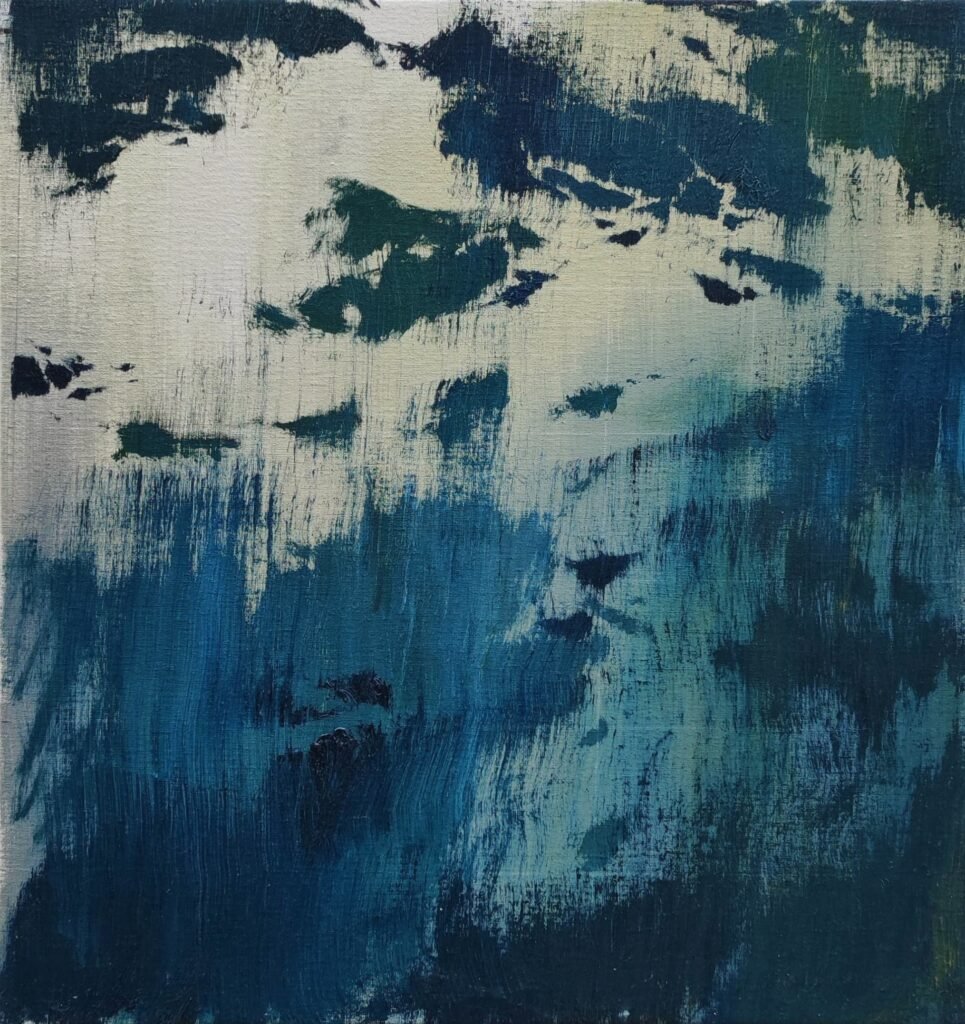
AZUL 2, 2022
Acrylic and oil on canvas by del in
Unique work, signed
H70 x L66 cm
Zabala alongside Chazme and Nelio for the group show Projections presented by Hatchikian Gallery and Quai 36.
The exhibition Projections, which juxtaposes the work of three artists working simultaneously on star-shaped walls, three artists who have established themselves as remarkable colorists, will be an opportunity for Zabala to take a specific period of creation to explore other directions in her approach in the studio. Realism remains the guiding thread of the work on various media, but the artist also turns to abstraction through close-ups and macro compositions, or through the stylization of figures tested in her technical experiments.
When Hatchikian Gallery and Quai 36 proposed to Zabala to be part of the Projections group show, he showed particular enthusiasm and found the project stimulating; Nelio and Chazme are for him indispensable and important references for positioning his own work. The idea of juxtaposing their approaches, both in what links them and what distinguishes them, inspired him with a creative impetus that will undoubtedly manifest itself in the works he is preparing for this exhibition.