

Post-graffiti expressionism in the New York underground of the 80s
In a period when conceptual and minimalist art constituted the dominant currents of contemporary American aesthetics, Basquiat’s universe emerged in a break from the mainstream, as neo-expressionist painting. Basquiat began his career very young, creating conceptual graffiti with his friend Al Diaz under the pseudonym SAMO. In the 1980s New York, the post-graffiti movement was marked by a shift from the street and urban surfaces to the studio and canvas, opening the way for young artists from the counterculture into the art market. Basquiat introduced writing into his paintings and freely combined mythology, spirituality, history, anatomy of the body, comics, advertising, and African-American heroes in the exaltation of a dazzling creative gesture and in the mode of free association. A unique graphic language that opens up an infinite number of questions and possible meanings for the viewer in the face of the density and complexity of each work. African-American culture is one of the recurring and dominant themes in Basquiat’s work. He affirms his mixed identity and his works often carry a political message denouncing racial and social inequalities. He highlights and emphasizes historical and legendary black figures, such as boxer Mohamed Ali, whose journey is inspiring, or Malcolm X. These are all prominent black figures from the world of culture, politics, or sports who played a decisive role in the recognition of African-Americans. These characters are portrayed as heroes and crowned with the artist’s signature symbol. This iconic crown usually accompanies the famous SAMO@ logo for «same old shit». Basquiat became one of the symbols of the underground and subversive urban culture of New York in the 1970s and 80s. In 1983, he was the youngest artist and the first black artist to be exhibited at the Whitney Museum Biennial. With his prolific and abundant work, he paved the way for the belated recognition of African-American artists, which the art market had long underestimated and which today enjoy a marked and amplified enthusiasm thanks to the Black Lives Matter movement. In his work, Basquiat claimed the ideas of the Black Power movement, which in the 1970s and 80s called for the union of blacks. Some of his works are critiques of the abuse of power exercised by the authorities or of police violence (cf. his work The Death of Michael Stewart in 1983). Basquiat was inspired by everything around him and curious about knowledge in various fields. Eclectic readings (fiction, medical treatises, history books), jazz music, rap as well as punk or pop: these are just some of the references that can be found in the complexity of his works, which are saturated with multiple dimensions.

A fascination for anatomical models
Basquiat’s work is haunted by the violence of death and by the bodies. At the age of 7, he was run over by a car while playing in the street. He says that this accident, which left him in the hospital for many weeks, is his most vivid childhood memory: «It was like in a dream. Exactly like in a movie, when the images play in slow motion. When a car runs you over, that’s what it looks like.» At the hospital, Basquiat receives from his mother the prestigious Gray’s Anatomy, a reading that occupied him throughout his convalescence. References to anatomical diagrams will permeate his work, and some of the paintings will be exclusively dedicated to the anatomy of the body. He even names his musical group «Gray», founded in 1979, in reference to the author of the anatomy manual published by Henry Gray in 1950, which he frequently reread. This group, created with the writer and multidisciplinary artist Michael Holman, was characterized by a very industrial sound.
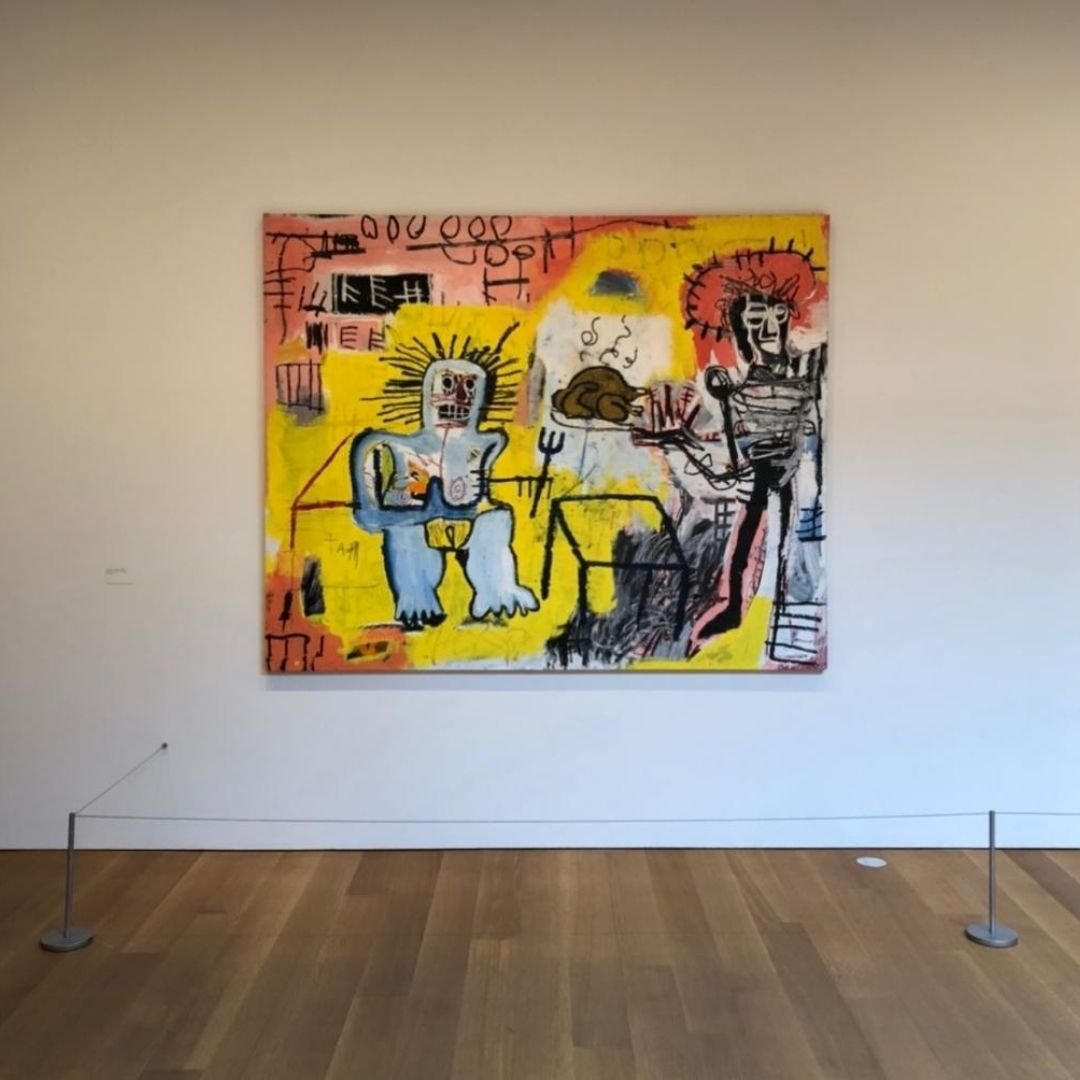
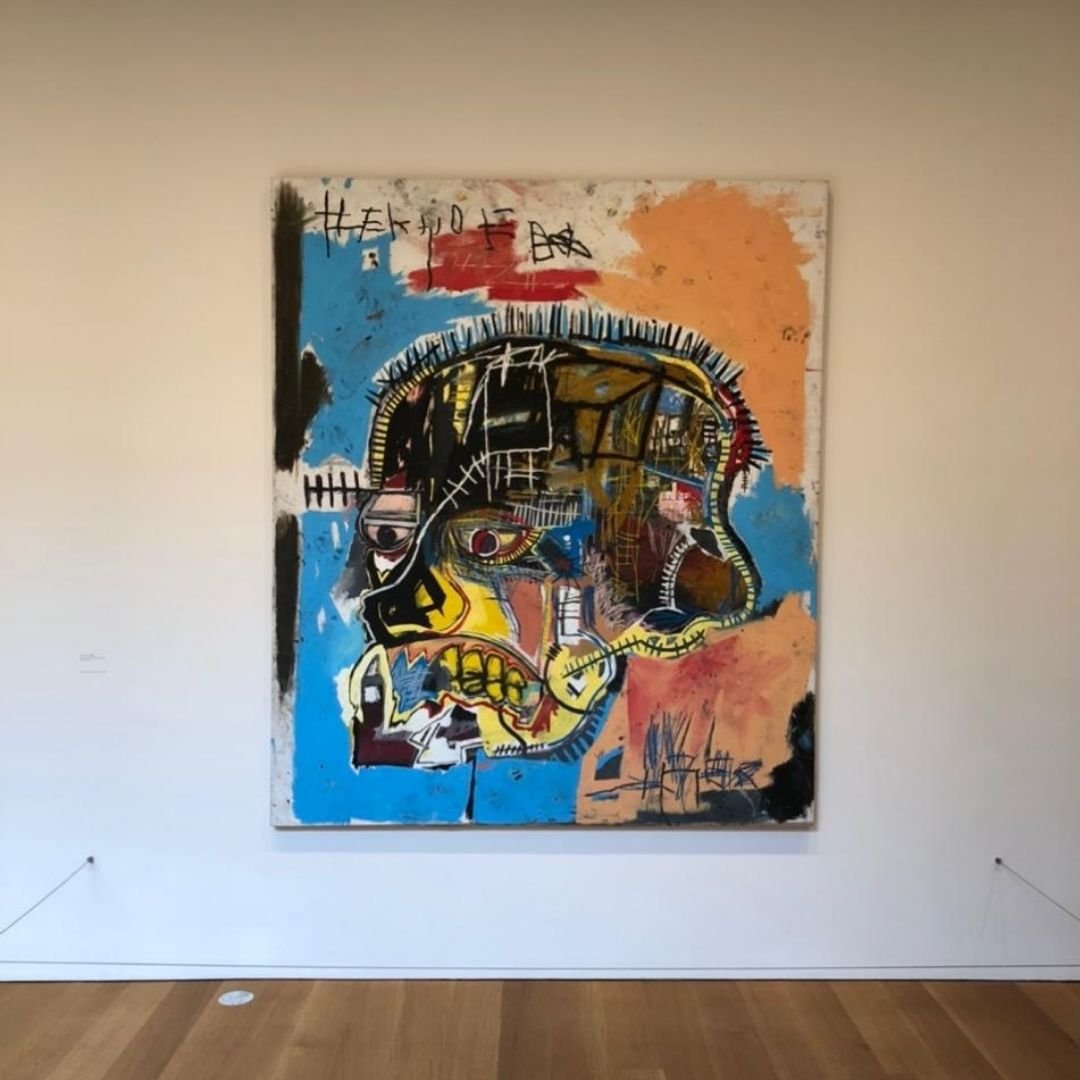


Exhibition at the Brant Foundation, NYC (April 2019)
Basquiat and Warhol
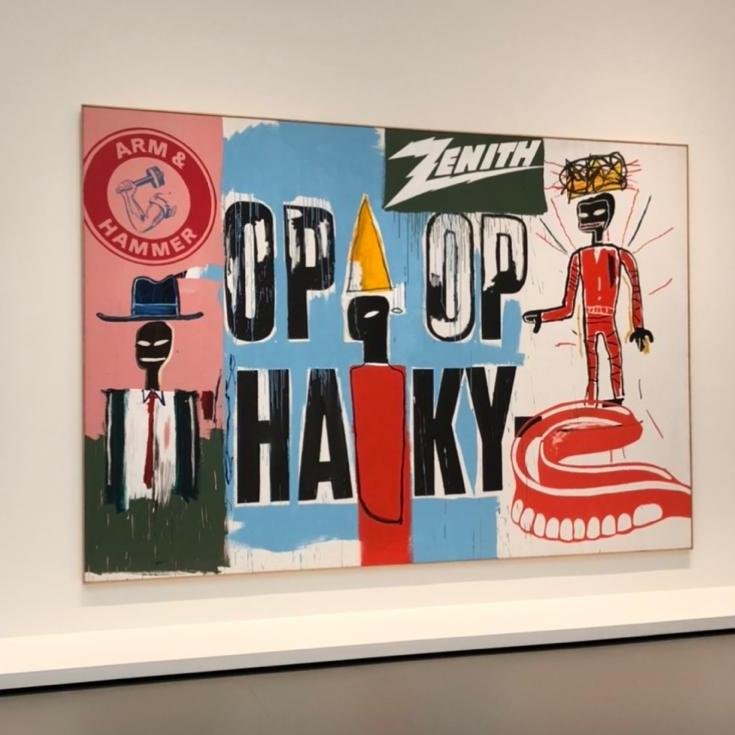
In the autumn of 1982, the art dealer Bruno Bischofberger organized the meeting at Andy Warhol’s Factory. A photograph of the two artists taken on this occasion inspired Basquiat to create his painting Dos Cabezas, which Andy Warhol enthusiastically accepted. From then on, an intense collaboration developed, leading to the joint production of a hundred paintings. With Warhol, Basquiat began using screen printing and came to paint in contact with the young artist. According to Keith Haring’s testimony, the relationship between Basquiat and Warhol was «a kind of physical conversation, which took place through colors, not through words.» Basquiat, of Haitian origin, had introduced his older brother to the issue of racial discrimination by encouraging him to wear a helmet for 24 hours to understand what black men might feel on a daily basis in America, and what the attitudes towards them were.
Among the emblematic works created by the four of them, we can mention Eiffel Tower, 1985, which was shown during the magnificent retrospective organized by the Fondation Vuitton, following a trip by the two artists to Paris. To begin the work, Warhol placed his silkscreened figures, two black Eiffel towers enhanced with white. Basquiat added green frogs to the acrylic as emblems of the French froggies, as well as the blue-white-red colors of the flag, deconstructing them through the play of planes, making the Eiffel Tower emerge like a rocket in the sky. The elements with Warhol’s iconic style are thus associated with the phantasmagorical universe of Basquiat, like a mischievous emergence within a stereotyped ensemble.
Their joint works of the 1980s, however, sparked some criticism: «This collaboration looks like one of Warhol’s manipulations. Basquiat gives the impression of being a too complaisant accessory,» wrote the art critic Vivien Raynor in the New York Times. «It was like a crazy marriage in the art world, and they formed a strange couple. Their relationship was symbiotic. Jean-Michel thought he needed Andy’s fame, and Andy thought he needed Jean-Michel’s fresh blood. Jean-Michel gave Andy an image of a rebel,» explained Warhol’s long-time studio assistant Ronny Cutrone in Victor Bockris’s book titled Warhol: The Biography. The collaboration was often turbulent: Andy Warhol wrote it himself in his Journal on October 7, 1984: «Jean-Michel is so complicated. You never know what mood he’ll be in, what he’ll have taken in.“ He becomes truly paranoid and repeats: ”You use me, you use me» « Basquiat seems to be affected by the criticism suggesting that he would be relegated to the role of accessory or mascot in the face of Warhol’s perverse manipulations. Starting in 1985, after the joint exhibition at Tony Shafrazi gallery (NYC) whose famous poster depicted Basquiat and Warhol as boxers, he took a step back and would not see Warhol again until his death in 1987. He would only survive for a year, realizing in tribute a triptych of doors in the style of a gravestone (Gravestone, 1987), doors on which are depicted a black tulip, a yellow cross, a heart-shaped head, and the word »Perishable”. Upon Basquiat’s death in August 1988 in the studio loft that Warhol had rented him at 57 Great Jones Street, his portrait by Wahrol can be found just next to the sink, testifying to a complex and unwavering attachment despite the distance and death.

Basquiat's success in France
In France, Basquiat’s success owes much to Enrico Navarra. Art gallery owner and publisher, he sensed Basquiat’s aura and tirelessly transmitted the passion for his fascinating work around the world. «I knew very well the 1980s. I spent more time in New York nightclubs than in galleries, but here, facing this work, I thought to myself: either I am an idiot or the work of this artist [Basquiat] is fantastic! […] I had seen his works at the Palladium in New York in the mid-1980s and, at the beginning of 1988, I bought two or three works in New York and, in October of the following year, I went to the FIAC with Jean-Louis Prat (then director of the Maeght Foundation). He had just bought a Basquiat work there, in his eyes one of the best artists of the second half of the 20th century. When I told him that I was preparing a group exhibition in which I intended to present two paintings by Jean-Michel that belonged to me, he replied: «No, what we need to do is an exhibition entirely dedicated to Basquiat.» I went home, phoned New York, bought ten paintings and we held our first Basquiat exhibition at the Navarra gallery, which was then located on rue du Faubourg-Saint-Honoré.» Disappeared a year ago, a few months after organizing a magnificent exhibition of Basquiat’s drawings in one of the exhibition galleries of Château La Coste, Enrico Navarra was a conduit of aesthetic emotions, creating bridges between art, architecture, literature and sparking luminous encounters between artists to open the frontiers of creation.

Major exhibitions and retrospectives that always spark enthusiasm
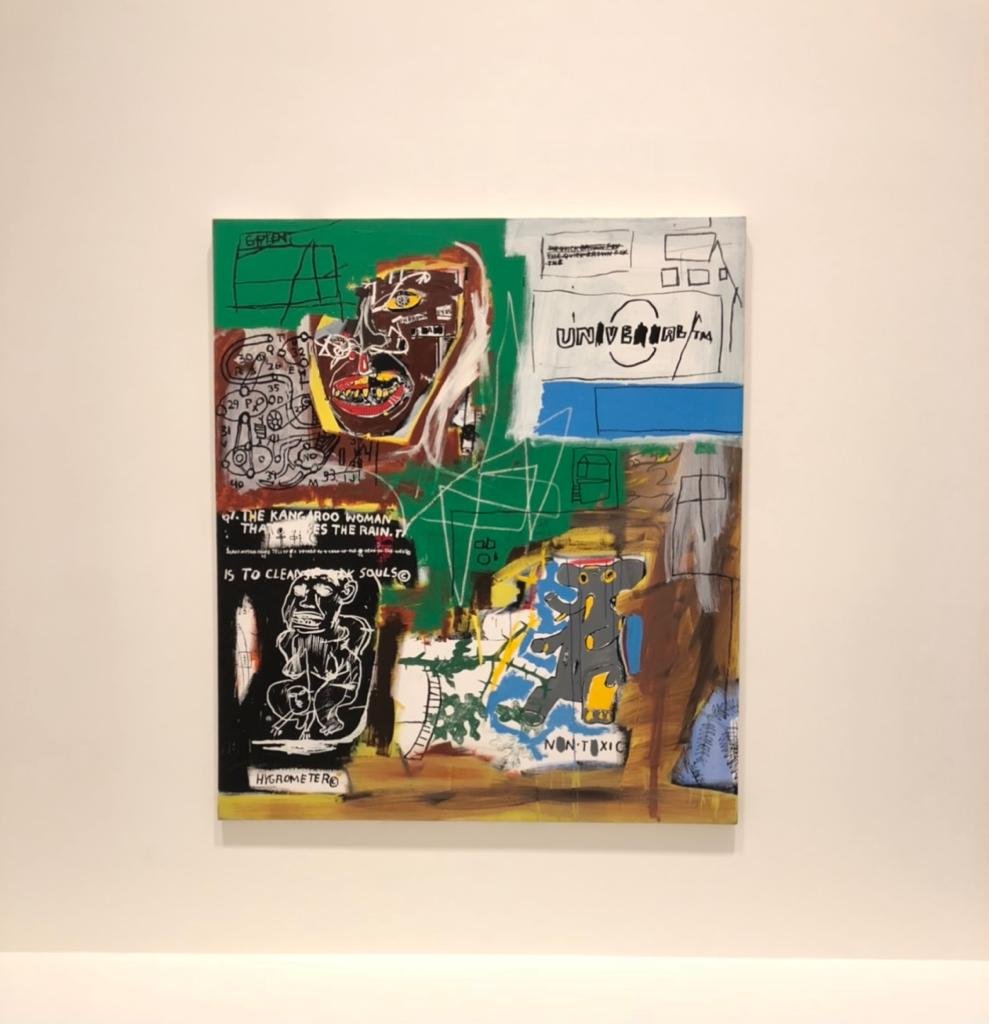
The first French retrospective was held at the Cantini Museum in Marseille in 1992. In 1984, it was included in an exhibition at the Museum of Modern Art in the city of Paris that compared free-form figuration in France with that in the USA. In 2010, the Museum of Modern Art in the city of Paris will organize a major retrospective, while the artist becomes an unparalleled figure in the art market, in collaboration with the Beyeler Foundation where she was first presented, on the occasion of the 50th anniversary of the artist who died of an overdose at just 27 years old. The success of this exhibition sealed Basquiat’s reputation in France, which has not diminished during the magnificent exhibition in 2018-2019 at the Fondation Vuitton, whose exceptional spaces allowed for the display of a vast and monumental work. Part of this exhibition was then presented at the Brant Foundation in New York, while the latter was inaugurating new premises not far from the apartment at 57 Great Jones Street where the artist lived for five years, created, and died in 1988. A studio-workshop that Basquiat had rented to Andy Warhol for 4,000 $ and in front of which today a plaque in memory of Basquiat and numerous dedicated works of street art recall his presence. Five years after his death, in 1993, the Whitney Museum presented a retrospective of Basquiat’s work, followed in 1997 by another major exhibition at the Mitsukoschi museum in Tokyo. In 2005, an exhibition was dedicated to him at the Brooklyn Museum, a tribute to the artist who grew up in this neighborhood of NYC, followed 10 years later by an exhibition centered on his notebooks, which shows how words and text are an integral part of Basquiat’s graphic language.
Basquiat's News
A major exhibition is ending this June in Boston at the Museum of Fine Arts: «Writing the Future». The works of Basquiat in painting, sculpture, drawing, video, music and fashion are presented alongside those of his contemporaries, some of whom the artist had the opportunity to collaborate with: A-One, ERO, Fab 5 Freddy, Futura, Keith Haring, Kool Koor, LA2, Lady Pink, Lee Quiñones, Rammellzee and Toxic. Throughout the 1980s, these artists, fueled by their creative energy, pushed new directions in the arts, design and music, contributing to the emergence of hip-hop culture. «Writing the Future: Basquiat and the Hip-Hop Generation» illustrates how the subversive abstractions of the visual and verbal language of this group with break-out practices propelled these artists to the forefront of the art and music scenes. It is the first major exhibition to contextualize Basquiat’s work in relation to hip-hop.
In the spring of 2022, more than 200 new works will be exhibited in New York, at the legendary Starr Leigh building in the Chelsea neighborhood. This is the first time since the artist’s death that the Basquiat family has made the archives available. Jean-Michel’s sisters have worked on designing an immersive experience to discover different aspects of his work in all dimensions of the pop culture universe. Because Basquiat, at the beginning of his artistic career, was also a musician, and left behind one of the rarest hip-hop records in the world, a 12-minute battle with MCs K-Rob and Rammellzee, which he produced in 500 copies with a hand-drawn cover. The album released in 1983 is titled Beat Pop. Basquiat also designed the cover for The Offs’ first album (1984).

The series of prints « Anatomy »
Hatchikian Gallery presents two silkscreen prints, artist’s proofs from the «Anatomy» series created by Basquiat in 1982. This series includes 18 anatomical plates inspired by the Gray’s Anatomy manual, given to the artist by his mother during his hospitalization at the age of 7 after an accident and which remained a regular and inspiring reference throughout his artistic career, demonstrating a true fascination for the architecture of the body. These anatomical plates translated into the graphic language of Basquiat relate to different types of bones, ligaments, muscles, organs, or even a skull. Hatchikian Gallery invites you to discover these works available in its collections.